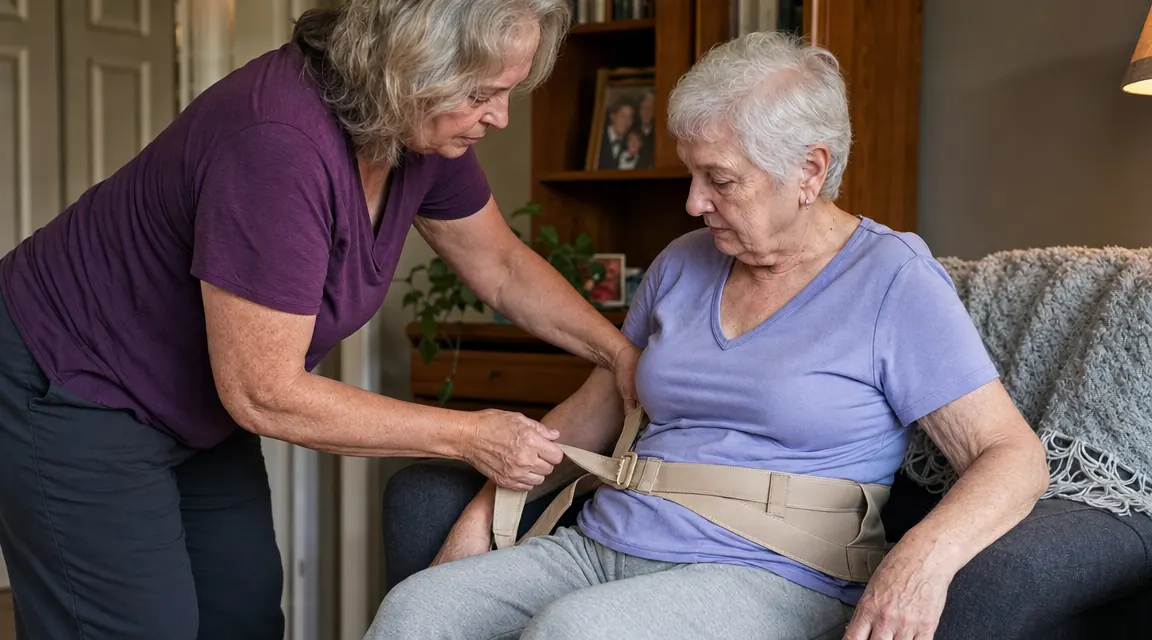
Most people who write about gait belts have used one a handful of times. I have used the LiftAid belt every single day for two years helping my mother go from bed to her wheelchair, from the wheelchair to the toilet, and back again. I already wrote about what held up over time and what surprised me after months of daily use. This piece is different. This one is about the things you will not learn from the product listing, from the five-star reviews, or from a nurse handing you a belt and saying 'just grab the loops.' These are the things I had to figure out the hard way, and I would rather you know them before your first transfer than after.
The LiftAid gait belt has a 4.8-star rating on Amazon with over 4,500 reviews. That rating is deserved. It is a good belt. But a 4.8 tells you what most people think after a week or two of use. It does not tell you about the buckle pinch, the length ceiling for heavier patients, what happens to nylon webbing after six months of daily use and once-a-week washing, or how the loop placement changes what you can and cannot do during a pivot transfer. That is what I am going to cover here.
The Quick Verdict
A reliable, well-made gait belt at a fair price, with a few specific friction points that are easy to work around once you know they exist.
Amazon Check Today's Price →If you are still using a cheap unbranded belt, or nothing at all, stop and read this first.
The LiftAid is the most-used gait belt in home-care settings for a reason. Metal buckle, reinforced loops, and webbing that does not stretch under load. Check today's price before you move on.
Amazon Check Today's Price on Amazon →The Buckle: Better Than Most, But There Is a Learning Curve
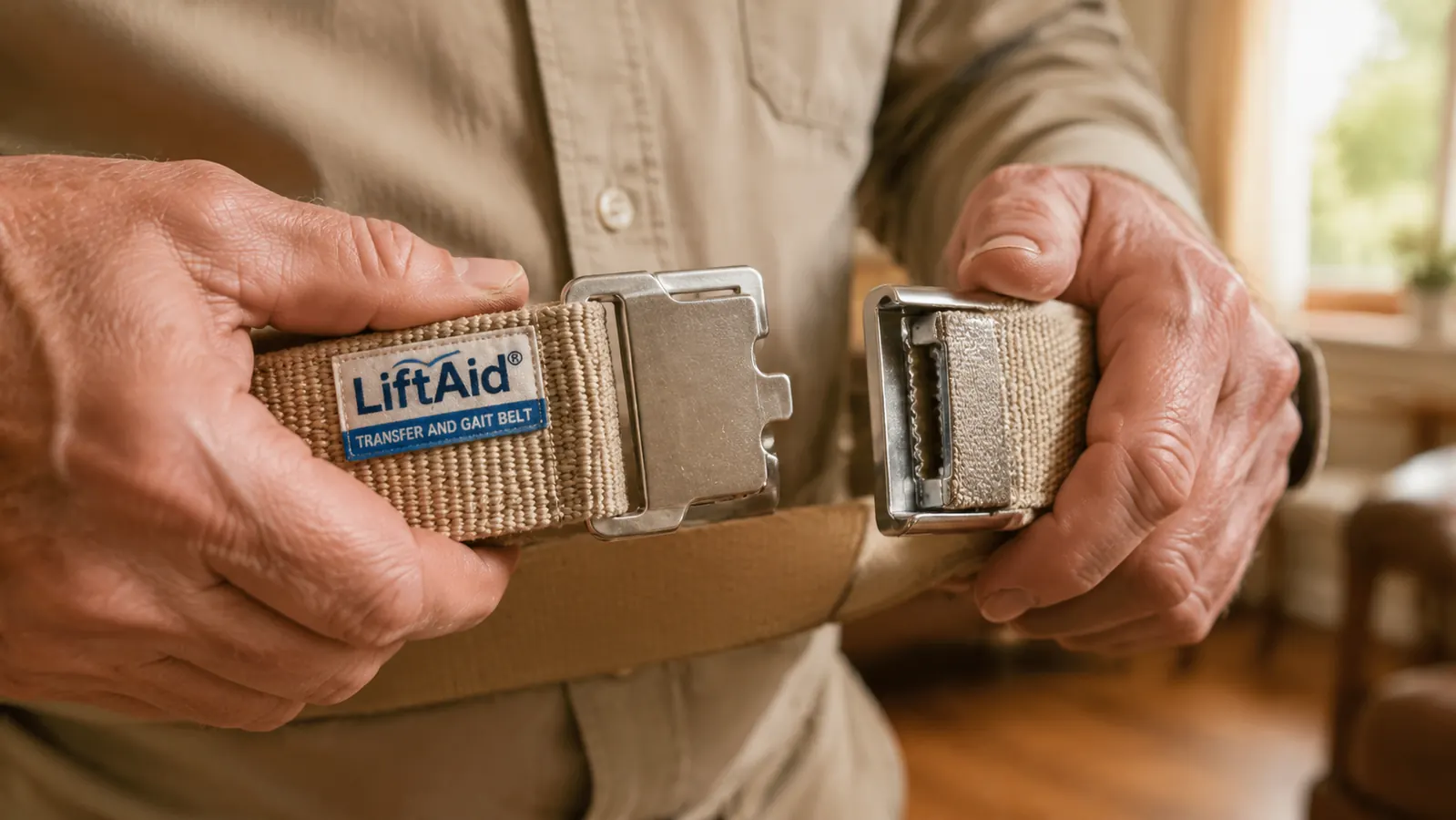
The LiftAid uses a metal quick-release buckle. If you have used plastic buckles on cheap belts, your first reaction to this one will be good: it feels solid, it locks with a positive click, and it does not flex when you pull against it during a transfer. All of that is true.
Here is what the listing does not mention: when the belt is new, that metal buckle is stiff. It takes real hand strength to release, especially if the belt is snugged up tight the way it should be for a transfer. For most caregivers that is a minor inconvenience. For a caregiver who has arthritis in their hands, or who has the patient wearing the belt all day between transfers, it can be a problem. The stiffness breaks in after about two weeks of regular use. Until it does, I recommend practicing the release motion a few times before you put it on your patient.
The second buckle issue is the pinch problem, and this one is entirely about sizing. The metal frame has two edges that line up when you thread the webbing through and cinch the belt. If the belt is sized correctly, those edges sit flush against each other and against the webbing. If the belt is one or two holes too loose, the edges ride up slightly and the gap between the frame and the webbing creates a pinch point. On a patient with thinner skin or any skin fragility, that gap will catch skin during a standing transfer when the belt tightens under load. The fix is simple: fit the belt so it is snug before the transfer, two fingers of clearance is the standard, and do not leave extra webbing threaded loosely through the buckle. Tuck the tail end.
The 60-Inch Length: Who It Fits, and Who It Barely Fits
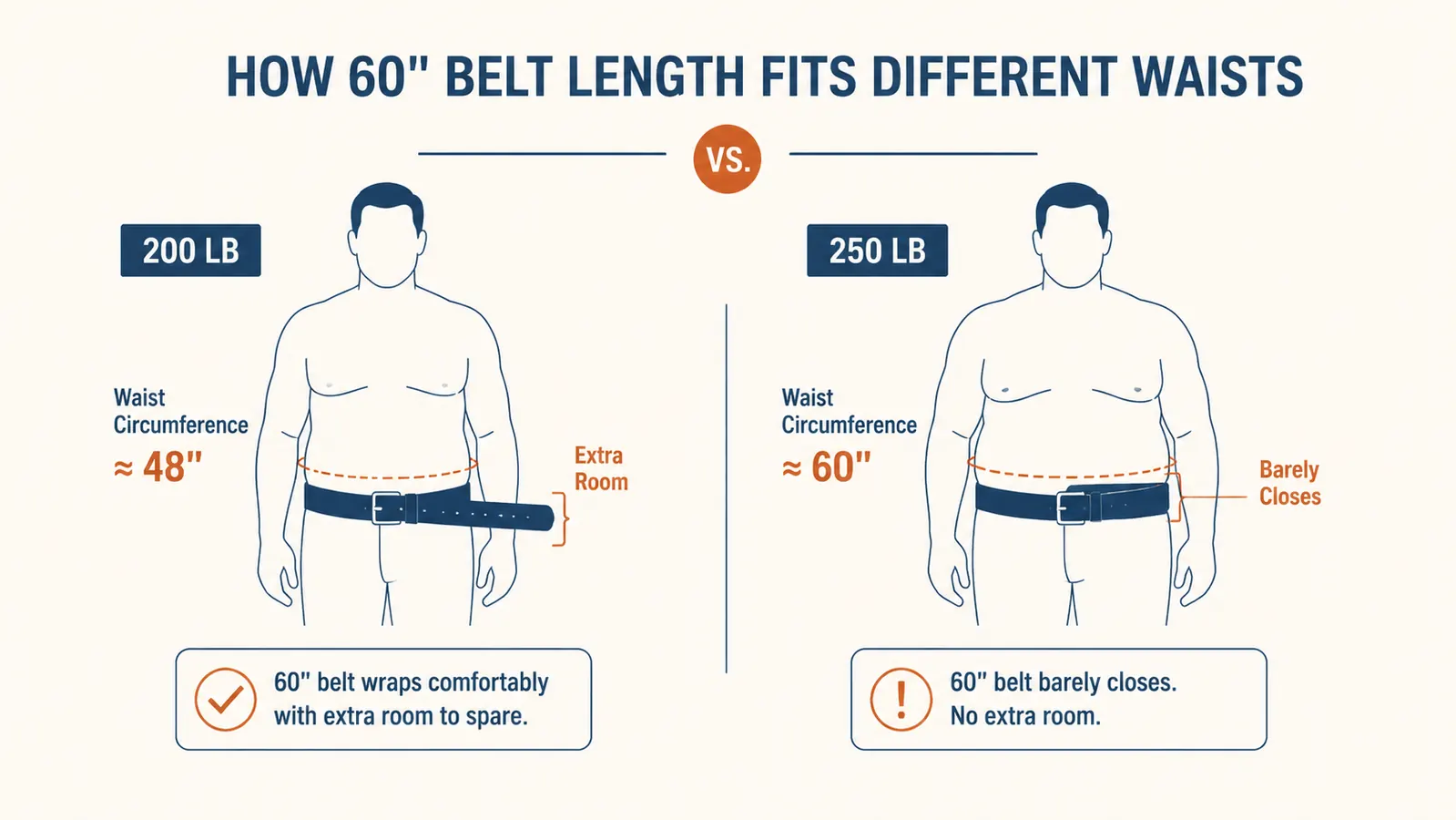
The LiftAid comes in one standard length: 60 inches. For most patients, that is more than enough. A patient with a 38-inch waist has room to spare. A patient with a 44-inch waist is starting to feel the constraint. A patient who weighs around 200 pounds at average height will have the belt fit correctly and still leave you three to four inches of working room past the buckle. That is fine.
At 250 pounds, depending on body shape, you may find yourself at the last notch or close to it. The belt will still work, but your adjustment margin is gone. Any patient carrying weight in their midsection, which is common in older adults with mobility issues, will find this belt at or near its limit at 250 pounds. At 275 or higher, you need to order the longer version or a different belt entirely. The product listing does mention a longer option, but it does not call out this ceiling directly, and that is information you need before you order, not after your patient is standing in front of you and the buckle will not close.
My mother is 160 pounds at 5 feet 3 inches. The belt fits her with plenty of room. If your patient is heavier or carries more width in their torso, measure their waist before ordering. Wrap a measuring tape where the belt would sit, at the natural waist or just above the hip bones, and add four inches for the overlap you need at the buckle. If that number is over 56 inches, order the longer belt.
The Odor Problem Nobody Mentions in the Reviews
Nylon webbing absorbs odor. That is not unique to LiftAid. It is true of every gait belt made from woven nylon, which is most of them. What nobody in the reviews tells you is how quickly this becomes a problem when you are using the belt daily on a patient who sweats, who has any skin breakdown, or who wears the belt for multiple transfers throughout the day.
After about three months of daily use without regular washing, the belt develops a persistent smell that does not come out with a quick rinse. By month four it is noticeable every time you take it out of the drawer. Wash it weekly, minimum. I run it through the washing machine in a lingerie bag on warm, then hang it to dry. Do not put nylon webbing in the dryer. The heat degrades the fibers and stiffens the weave, and the stitching around the loops will start to pucker before the rest of the belt shows any wear. The metal buckle survives the washer without rusting, which I was concerned about the first time I ran it through. It is fine.
Keep a second belt on hand if you can. Eight dollars is not a lot of money to have a backup ready to go while the first one is drying. I bought a second LiftAid six months in and now I rotate them. One dries overnight while the other is in service. That alone ended the odor problem for me.
Wash it weekly, minimum. Keep a second belt in rotation. Eight dollars for a backup is the easiest maintenance decision in home caregiving.
The Loops: What They Are Good For and What They Get in the Way Of
The LiftAid has six loops sewn along the length of the belt at roughly even intervals. The loops are one of the reasons this belt is better than a plain flat belt. They give you something to grip that is secure, predictable, and positioned correctly without having to fumble for a handful of webbing during a transfer. For a standing assist, a walking assist, or a simple sit-to-stand, the loops are genuinely helpful.
Here is where they become a liability: pivot transfers. A pivot transfer is when you are moving a patient from one seated surface to another, a bed to a wheelchair or a wheelchair to a toilet, by rotating them on one foot while you support most of their weight. In a pivot transfer you often need to slide your grip along the belt as the patient rotates, repositioning your hands quickly as their center of mass shifts. On a flat belt that slide is smooth. On the LiftAid, the loops create friction points every few inches. Your grip catches on the loop edge during the slide, which interrupts your motion and can pull the patient slightly off-balance during a critical moment.
The workaround is to plan your grip position before the transfer starts. Choose your loop placement, put your hands there, and do not try to slide mid-transfer. For most home caregivers who have one patient and one routine, this becomes second nature within a week. But if you are a professional caregiver or home health aide working with multiple patients with different transfer needs throughout the day, the loop bulk is something to be aware of. For those users, a plain flat-weave belt with sewn handles might actually work better for pivot-heavy situations. For home use with a consistent patient, the loops are more useful than they are a problem.

The Cheap Unbranded Belt: Why I Am Telling You to Avoid It
Search for gait belts on Amazon and you will find belts with no brand name, no manufacturer address, and prices starting around four dollars. Some of them look almost identical to the LiftAid. The webbing is a similar color, the buckle is a similar shape, and the photos show loops in roughly the same positions. I want to tell you plainly: do not buy those belts for transferring a human being.
The issue is not that they look cheap. The issue is the buckle and the stitching. A gait belt takes a sudden, significant load during a transfer. If a patient starts to fall, the belt goes from low tension to full body-weight tension in a fraction of a second. That is the moment the buckle has to hold. On cheap unbranded belts, the buckle is typically die-cast plastic or a low-grade metal alloy that has not been tested under that kind of shock load. The stitching at the loop attachment points is often single-pass rather than bar-tacked. I have had one of those buckles let go in my hand. Not during a full fall, but during a routine sit-to-stand when my mother leaned further than expected. The buckle released under load and I grabbed her by the arm. She was fine. I was not calm for the rest of the afternoon.
The LiftAid costs eight dollars. The difference between eight dollars and four dollars is not worth the risk you take with the cheaper option. Buy the one that has 4,500 reviews from real caregivers and a metal buckle that has been used millions of times without a documented failure mode. This is not the place to save four dollars.
LiftAid vs the Posey Belt: What the Hospital Uses and Why
If your parent spent time in a hospital or a rehabilitation facility, the gait belt you saw the nurses using was likely a Posey belt. Posey is the brand that dominates institutional settings. Hospitals buy Posey in bulk, they keep them in every room, and the nursing staff is trained on them specifically. When my mother came home from her first hospitalization, the discharge nurse showed me her Posey belt and told me to get one for home use.
I tried a Posey belt for about three months before switching to the LiftAid. Here is how they actually compare. The Posey is a wider belt, typically two inches to the LiftAid's one and a half inches, which distributes pressure slightly better across the patient's lower back. For a patient with significant back tenderness or spine involvement, the wider belt is a real comfort difference. The Posey buckle is also extremely well-built and requires almost no break-in period. On those two points, Posey wins.
The trade-offs: Posey belts are significantly more expensive when you buy them through retail rather than the institutional supply chain. A single Posey belt purchased outside of medical supply procurement runs twenty to thirty-five dollars depending on size and retailer. The LiftAid is eight dollars. Functionally, for home use with a consistent patient, they are not thirty dollars apart in performance. The LiftAid loops are positioned better for a solo caregiver than the Posey handles, which are designed for two-person assist scenarios. The LiftAid is also available on Amazon with next-day shipping, which matters when a belt wears out on a Wednesday evening and you have a morning transfer scheduled.
My honest take: if your parent has significant back issues and you have the budget, look at the Posey for the comfort advantage. For the majority of home caregivers working with a patient who has normal back sensitivity, the LiftAid is the right call. Better loop placement for solo use, equivalent safety performance for home-transfer loads, and the price difference buys you two backup belts.
What I Liked
- Metal buckle holds under load without flexing or releasing unexpectedly
- Loop placement works well for solo standing assists and walking assists
- Survives machine washing without rusting or warping
- At eight dollars, you can afford a backup belt in rotation
- 60 inches is sufficient for patients up to approximately 230-240 pounds depending on body shape
- Better loop positioning for solo caregivers than institutional alternatives
Where It Falls Short
- Buckle is stiff for the first two weeks and difficult for arthritic hands
- Metal frame edges can pinch skin if the belt is not sized snugly before transfer
- Loops add friction that interrupts sliding grip during pivot transfers
- 60 inches is at the limit for patients around 250 pounds; order the longer version for heavier patients
- Nylon webbing absorbs odor with daily use; requires weekly washing and a backup belt in rotation
- Narrower than a Posey belt, which matters for patients with significant back tenderness
Who This Is For
The LiftAid gait belt is the right choice for a home caregiver who is doing daily or multiple-times-daily transfers on a patient who weighs under 240 pounds. If you are performing standing assists, walking alongside your patient down a hallway, or doing a simple bed-to-chair transfer, this belt gives you a secure grip, a reliable buckle, and enough length to work with. It is also the right choice if you are new to gait belt use and need something you can order tonight and have confidence in tomorrow morning.
Who Should Skip It
Skip the standard LiftAid and order the longer version if your patient weighs 250 pounds or more, or if they carry significant weight in their midsection. Look at a Posey or a wider institutional belt if your patient has a back injury, a compression fracture, or any condition that makes the pressure of a belt against their lower back genuinely painful. And if you are a home health aide doing pivot transfers on multiple patients throughout the day and you need to slide your grip quickly during rotation, try a flat-weave belt with sewn handles rather than the looped design.
You know the friction points now. If the LiftAid fits your situation, today's price is still under ten dollars.
Metal buckle, six grip loops, 60 inches, machine washable. It is what most home caregivers need for daily transfers. Check current price and availability on Amazon.
Amazon Check Today's Price on Amazon →