

My mother is 91. She weighs about 110 pounds, but getting her from bed to wheelchair to commode and back again is not a light job. I do it four or five times a day, seven days a week. For the first few months I was doing it the way most people do it when nobody teaches them anything: grabbing her arm, her shoulder, whatever I could get hold of, praying she did not tip sideways. My lower back let me know what it thought of that arrangement. Then a physical therapist at her doctor's office handed me a gait belt and said, put this on her every time before you move her. That was two years ago. The LiftAid Transfer and Gait Belt is what I ordered, and it is what I have been using ever since.
I am not a nurse. I am not a physical therapist. I am a 71-year-old man who used to sell wholesale food and tobacco and now spends his days being the person my mother needs me to be. I bought this belt for under $8. I want to tell you what two years of daily use actually looks like.
The Quick Verdict
The most cost-effective piece of caregiving equipment I own. The metal buckle is the right call, the 60-inch length works for larger patients, and after two years of washing it holds together. The loops could be positioned a little better for shorter caregivers, but that is a minor complaint.
Amazon Check Today's Price →If you are doing transfers without a gait belt, your back is paying for it. Here is today's price.
The LiftAid 60-inch belt with metal cam-lock buckle has a 4.8-star rating from over 4,500 verified buyers, most of them caregivers in exactly the situation you are in. Under $8 on Amazon.
Amazon Check Today's Price on Amazon →How I Have Been Using It
My mother sleeps in a hospital bed in the room that used to be the guest room. The routine starts around 7am. I go in, get her sitting upright, put the gait belt on her over her nightgown, and walk her to the wheelchair. That is transfer one. Then it is the wheelchair to the commode in the bathroom, which is probably the hardest move because the space is tight and she needs a full stand-and-pivot. That is transfer two. Back to the wheelchair after. Throughout the day there are usually two or three more: back to bed for a rest, up for lunch, over to the recliner in the afternoon. At the end of the day it is the recliner to the wheelchair, wheelchair to bed. On a busy day I am doing this six or seven times.
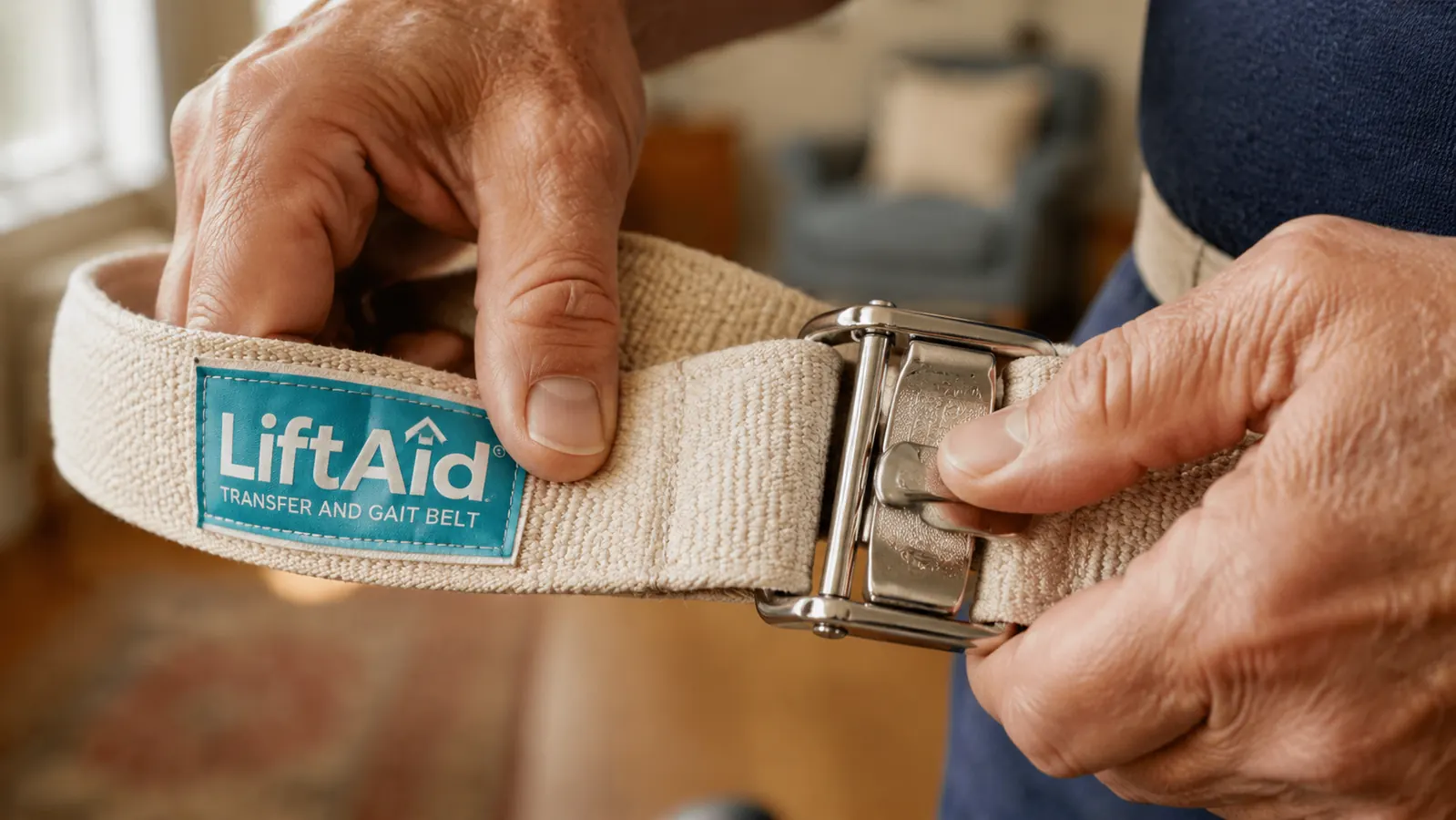
Before the belt, I was reaching under her arms and lifting. That motion, repeated four-plus times a day, seven days a week, will destroy a caregiver's back inside of a year. What the gait belt does is change the geometry. Instead of me hunching over and lifting upward from her armpits, I am gripping the belt at her waist level with both hands, keeping my back straight, and using my legs. She pushes with her feet, I stabilize and guide. It is a fundamentally different motion, and my back knows the difference.
I wash the belt every three or four days. It goes in the washing machine with her laundry on a warm cycle and gets hung to dry. After two years and somewhere north of 200 wash cycles, the canvas is slightly softer than it was new but structurally the same. No fraying on the edges, no stretch I can detect. The stitching at the loop attachments is intact. I did not expect an $8 belt to hold up this well.
The Buckle: Why Metal Matters
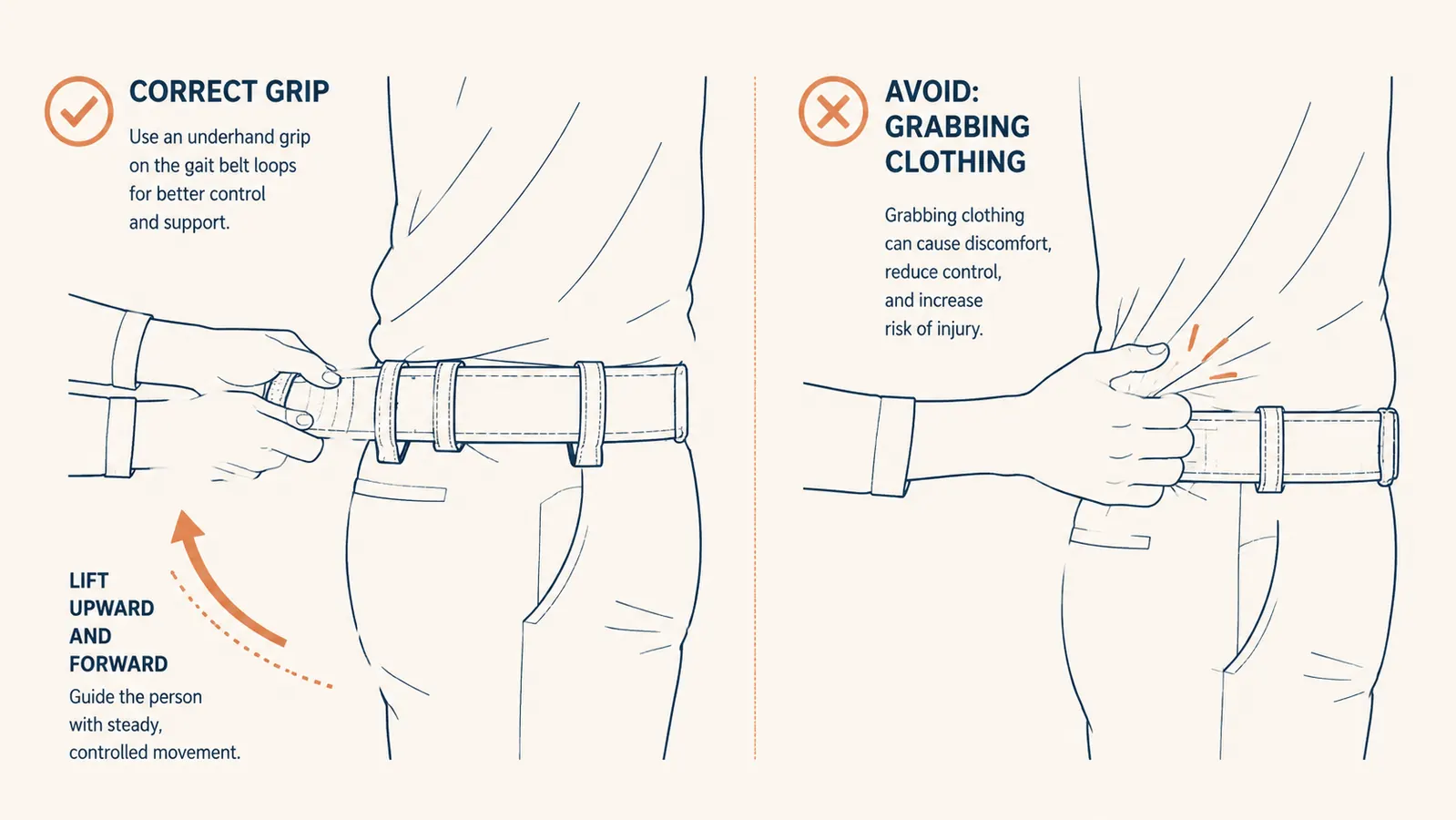
There are two types of gait belt buckles: plastic and metal. I had a plastic buckle belt briefly, borrowed from a neighbor before I ordered my own. Plastic buckles use a squeeze-release design similar to a car seatbelt. They work fine for occasional use. But plastic fatigues. After enough cycles of snapping it shut and pressing the release tabs, you start to wonder. You also notice that a plastic buckle, if your mother's hip catches it against the wheelchair arm during a transfer, will flex in ways that make you uncomfortable.
The LiftAid belt uses a metal cam-lock buckle. You thread the belt end through the frame, pull to tighten, and the cam grabs and holds. To release, you lift the cam lever and the belt loosens immediately. Once you learn the motion it takes about four seconds. The metal does not flex, does not fatigue the way plastic does, and if she bumps it against the chair it just clanks. I can put two fingers under the belt to check tension, which the physical therapist told me is the correct fit: snug enough that it does not ride up, loose enough that you can fit two fingers under it. The metal buckle makes it easy to dial that in.
My one complaint about the buckle is that it takes a little practice. The first three or four times I used it I fumbled with the threading. There is a specific way the tail has to feed through the frame to engage the cam correctly. Once you know it, it is faster than plastic. But nobody explains that in the packaging. I figured it out by watching a YouTube video. If you buy this belt, do that before your first transfer.
What a 60-Inch Belt Actually Gets You
Most standard gait belts are 54 inches. The LiftAid comes in 60. My mother is a small woman, so the extra length is not about circumference for me. It is about how much tail you have to work with after you fasten the buckle. With a 54-inch belt on a 110-pound person, you end up with a very short tail flapping around. With 60 inches, there is enough length to tuck the tail in neatly, which prevents it from catching on the wheelchair when she sits down.
For caregivers helping a heavier person, the 60-inch length matters more directly. A larger waist circumference that would leave a 54-inch belt too short to fasten safely can often be accommodated by a 60-inch belt. I know two other caregivers in my circle. One is helping her husband who has Parkinson's and weighs about 220 pounds. She ordered the LiftAid specifically because of the 60-inch length. It fits him with room to spare. The loops sit in a usable position on someone his size. On a smaller person like my mother, the loops end up on the sides of her hips, which is fine.
The Loops and How to Actually Use Them
The LiftAid belt has multiple fabric loops sewn into the belt itself. These are your primary grip points during a transfer. The idea is that you grip the loops rather than grabbing the flat canvas, which gives you more control and a more secure hold, especially if your hands are not as strong as they used to be.
In practice, I use a mix. For the standing transfer from bed, I grip two loops at roughly the 10 and 2 o'clock positions on her waist. For the pivot to the wheelchair, I shift one hand to a loop at her back and keep one hand at her hip, which gives me rotational control. I am 5-foot-11 and she is about 5-2, so the geometry works reasonably well for me. I have heard from shorter caregivers, 5-4 or 5-5, that the loops on a shorter patient can sit at an awkward angle. If you are significantly shorter than your patient, test the loop positions on the first use and see if you need to slide the belt around on her waist to get the loops where you need them.
The loops are double-stitched. I have pulled hard on them during a couple of near-falls where my mother started going sideways and I had to catch her weight quickly. The loops held. That is what you need to know.
A gait belt does not make transfers easy. It makes them survivable for both of you. Your back gets to keep working another year. That is the actual value.

Performance Over Two Years: Washing, Wear, and the One Thing I Would Fix
The canvas is beige cotton. It picks up stains from whatever your parent is wearing or whatever is on their skin. Lotion, coffee, the occasional accident. It washes out. I have used warm water with regular detergent hundreds of times. The color has faded slightly, as beige cotton does. There is no structural change. The stitching at the loops, which is the high-stress point, has not loosened or frayed in two years of real use including some emergency catches.
The one thing I would change: I wish the loop positions were printed or marked on the belt so that you can reset them consistently after washing. When I pull the belt out of the laundry and put it on her, I have to orient it correctly so the buckle is at the front and the loops are positioned where I expect them. It takes ten seconds but it adds a small moment of fumbling in the morning when she is sitting on the edge of the bed and we are both still waking up. A simple arrow or mark on the belt to indicate front-center would solve it. That is a $0.02 fix that LiftAid has not gotten around to.
I have owned two of these belts. The second one is my backup, kept in the car in case I am ever at my mother's doctor's office or PT and need to move her somewhere the facility does not have one. The backup has been used maybe 50 times and looks almost new. The primary belt, with 200-plus washes and 2,000-plus transfers, looks worn but functions perfectly.
What I Liked
- Metal cam-lock buckle is more reliable than plastic and does not fatigue with heavy daily use
- 60-inch length accommodates a wider range of patient sizes and leaves enough tail to tuck cleanly
- Multiple fabric loops provide secure grip options for different transfer positions
- Holds up to machine washing on warm without fraying or stretching after two years of use
- Under $8, which means you can buy a backup without thinking about it
Where It Falls Short
- Buckle threading takes practice; not obvious on first use and there are no clear instructions in the packaging
- Loop positions are not marked, so you have to orient the belt carefully each time you pull it from laundry
- Beige canvas shows staining from lotion and transfer residue between washes
What This Belt Does for Your Own Body
I want to spend a moment on this because most gait belt reviews focus entirely on the patient. The patient's safety is the headline, but caregiver back injuries are the thing that ends a home care arrangement. When a home caregiver blows out their lumbar doing a transfer, the patient goes to a facility. That is the stakes.
Without a gait belt, a caregiver's instinct during a transfer is to reach under the patient's arms or around their torso, which puts you bent at the waist with your back in full flexion while you bear load. That is the exact position that causes disc injuries. With a gait belt, your hands are at roughly waist height on the patient, which means you can stand more upright, hinge at the hips rather than the waist, and use the muscles in your legs and glutes rather than your lumbar chain. It is not a complete solution. You still need to move carefully, position your feet correctly, and not try to do it all yourself when the transfer requires more than one person. But the belt changes the fundamental mechanics in your favor.
My lower back went from hurting four days out of seven to hurting maybe once a month. I attribute most of that improvement to using the gait belt consistently. There is some luck in there too. But the change was significant enough that I recommend it to every caregiver I talk to, without exception. For details on specific techniques that protect your back during transfers, see our article on 10 ways a gait belt protects your back when moving an elderly parent.
Who This Is For
This belt is for home caregivers doing assisted transfers. If you are helping a parent or spouse stand from bed, walk to the bathroom, or transfer from wheelchair to commode, you need a gait belt and this one is a solid choice. It is for people who are doing this alone, without a nursing aide, more than once a day. It is for caregivers who are not 25 years old with perfect backs and who cannot afford to get hurt. It is for people who learned what a gait belt was the same way I did: from a physical therapist who assumed you already knew, when you did not. For a comparison of how a gait belt stacks up against other transfer options, the article on gait belt vs. transfer board for caregivers lays it out clearly.
Who Should Skip It
If your patient is non-weight-bearing, a gait belt is not the right tool on its own. A gait belt is designed for patients who can contribute at least some effort to the transfer, pushing up with their legs or shifting their weight. For a fully dependent transfer, you need a mechanical lift, a sit-to-stand device, or a second person. The gait belt helps guide and stabilize; it does not replace the patient's participation. If your situation is a full two-person lift every time, talk to an occupational therapist before settling on any single piece of equipment.
Two years of daily use. Under $8. Still working. Here is where to order it.
The LiftAid 60-inch gait belt with metal cam-lock buckle is one of the most reviewed transfer aids on Amazon, with a 4.8-star average from over 4,500 caregivers, nurses, and physical therapists. If you are doing transfers without one, your back is working harder than it has to.
Amazon Check Today's Price on Amazon →