
My mother came home from hip replacement surgery on a Tuesday afternoon. The discharge nurse handed us a sheet of paper with a list of things to have in place before she got back. Near the top of the list: a raised toilet seat. Not a suggestion. A requirement. Standard toilets sit around 15 inches high, and after a hip replacement, bending your hip past 90 degrees is exactly what the surgeon has told you not to do. A standard toilet forces that bend. A raised seat eliminates it.
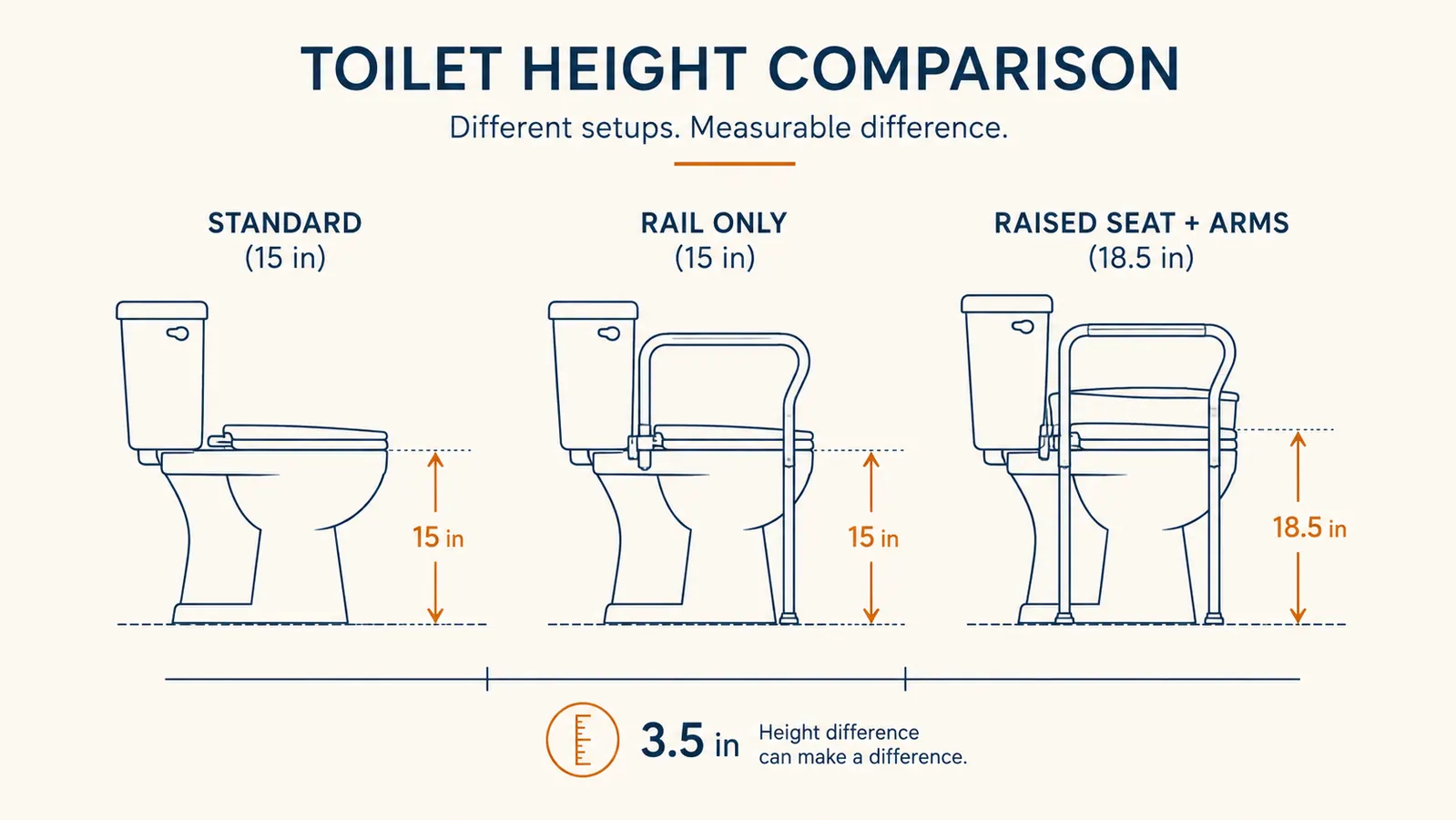
Here is where most caregivers get confused. They see two different products on Amazon and are not sure which one the doctor meant. A raised toilet seat lifts the seating surface 3 to 4 inches so the user does not have to bend as far. A toilet safety rail clamps to the toilet tank and gives the user something to grab and push off of, but it does not change the height at all. One product addresses height. The other addresses grip and stability. They solve different parts of the same problem. And there is a third option that handles both at once, which is what I ended up buying and what most caregivers in this situation actually need.
| attribute | left | right |
| attribute | left | right |
| attribute | left | right |
| attribute | left | right |
| attribute | left | right |
| attribute | left | right |
| attribute | left | right |
| attribute | left | right |
Where the Drive Medical Raised Seat Wins
The most important thing a raised toilet seat does is change the geometry of sitting down and standing up. When your parent lowers themselves onto a surface that is 18 or 19 inches off the floor instead of 15, their knees and hips do not have to travel as far. That translates directly to less pain, less strain on repaired joints, and lower fall risk. After my mother's surgery, her physical therapist told us that the toilet was one of the two highest-risk moments in her day. The other was getting in and out of bed. A raised seat addressed the toilet risk immediately.
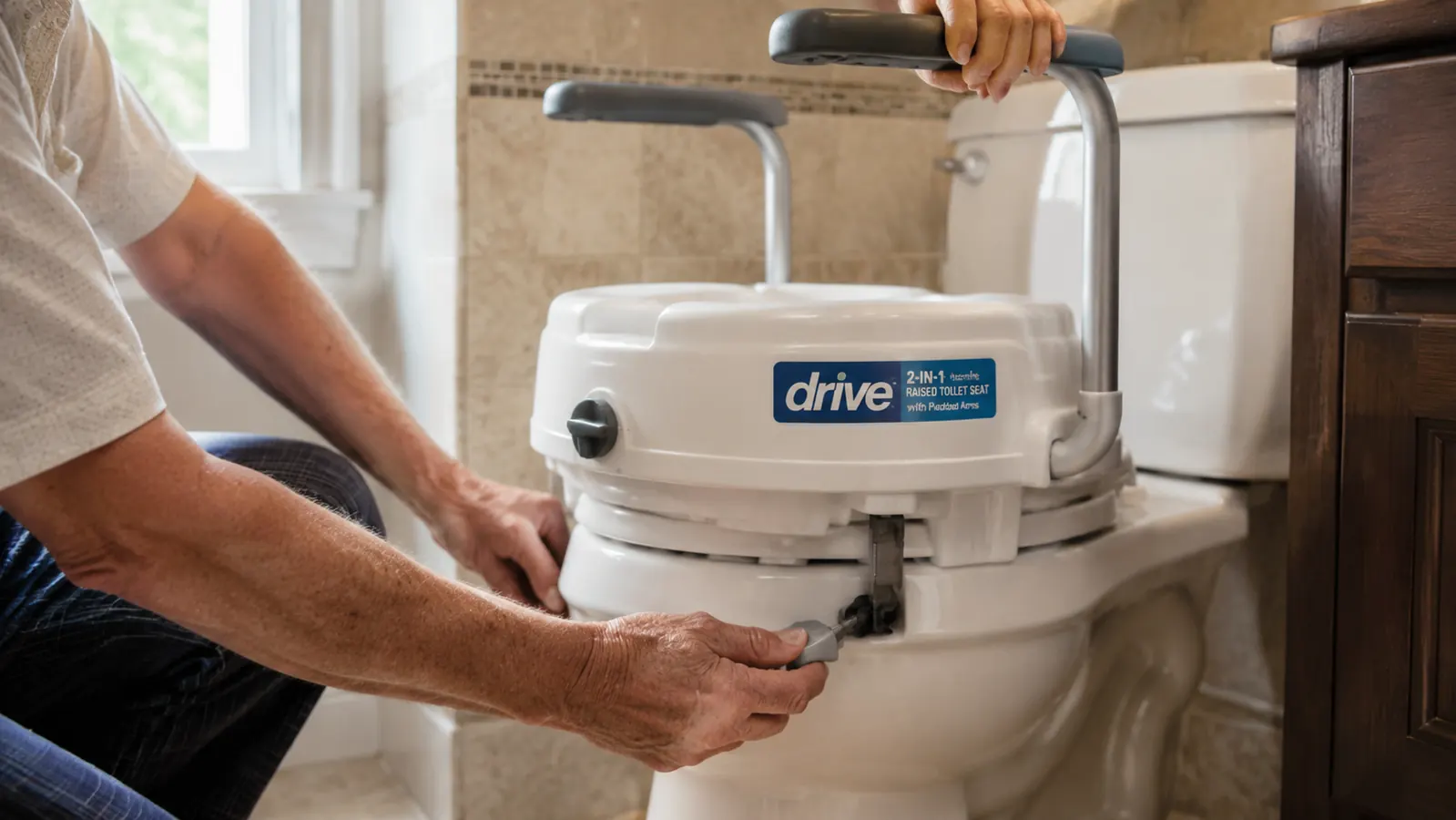
The Drive Medical 2-in-1 takes it a step further by putting padded arms on both sides. Those arms are not the flimsy clamp-on rails you see on cheaper models. They are wide, padded, and positioned correctly so your parent can press down with both palms to push up. That is a fundamentally different motion than grabbing a rail and pulling. Pushing up from a solid, wide surface is easier, more stable, and puts less strain on the upper back and shoulders. My mother used those arms every single time. After about two weeks, she stopped asking me to stand nearby. The arms gave her enough confidence to manage the transfer on her own.
Where a Standalone Safety Rail Wins
A standalone toilet safety rail is a reasonable product for a specific situation: someone who has good leg strength and enough hip mobility to get on and off a standard-height toilet, but who needs something to hold for balance and reassurance. Think of a 68-year-old who had a recent bout of dizziness, or someone early in a Parkinson's diagnosis who is still physically strong but wobbles a bit when transferring. The rail gives them a confidence anchor. It is also simpler to install since you do not have to remove the existing toilet seat.
The other place a standalone rail makes sense is a guest bathroom that multiple people use. If the rail can stay on without disrupting anyone else, it is a lower-cost, less-invasive option than a raised seat that changes the feel of the toilet for everyone. Some families put a raised seat in the primary bathroom where the senior spends most of their time, and a rail in the secondary bathroom as a backup.
The toilet safety rail solves the grip problem. The raised seat solves the height problem. After my mother's hip surgery, she needed both solved at once. That is exactly what the Drive Medical 2-in-1 is built for.
The Post-Hip-Surgery Height Requirement
This is worth saying plainly because the discharge paperwork does not always say it clearly. After a total hip replacement, the standard precaution is to avoid bending the operated hip past 90 degrees for a period of roughly 6 to 12 weeks, depending on the surgeon and the procedure. A standard toilet at 15 inches forces most adults into a hip angle well past 90 degrees. A toilet with a 3.5-inch raised seat brings the surface to about 18.5 inches, which is close to what a standard chair or couch offers. That is the geometry that keeps the new joint safe.
A toilet safety rail does nothing about this. It is still a 15-inch seat. The rail might help your parent lower themselves more slowly and with more control, which is better than nothing, but it does not remove the high-risk hip angle. If the discharge sheet says raised toilet seat, a safety rail is not a substitute. Get the raised seat.
Your parent's surgeon prescribed a raised seat for a reason. This Drive Medical model adds 3.5 inches of height plus padded arms to push off of.
The Drive Medical 2-in-1 Raised Toilet Seat installs in about ten minutes, fits standard and elongated toilets, and holds up to 300 lbs. It is the single product that handles both the height and the grip problem at once.
Amazon Check Today's Price on Amazon →Arms vs Rails: How They Actually Feel Different
I want to be clear about this because I have used both. The motion of pushing off wide padded arms is different from the motion of gripping a narrow metal rail. When you push off arms, your palms press down on a horizontal surface and your triceps do the work. It is similar to pushing up from a chair. Most people can do that motion even with significant weakness. When you grab a rail, you are pulling yourself up at an angle, which requires more grip strength and recruits your shoulder and bicep in a way that many older adults, especially those with arthritis, find difficult or painful.
The Drive Medical arms are padded, which matters more than it sounds. A bare plastic or metal arm surface can be uncomfortable against the thigh, and some users will unconsciously avoid leaning on it because of that discomfort. The padding also makes the arms easier to grab quickly if your parent starts to lose balance mid-transfer. Small detail, but it comes up.

Who Should Buy Which
Buy the Drive Medical 2-in-1 Raised Toilet Seat if: your parent is recovering from hip or knee surgery, has moderate to severe arthritis in their knees or hips, has limited leg strength and relies on arm-push to stand up anywhere, or if you want one product that does everything the bathroom needs. This covers the large majority of caregivers who land on this comparison.
Consider a standalone safety rail if: your parent has strong legs and good hip mobility but just wants a grab point for balance, or if height is genuinely not an issue and you are working with a toilet that is already taller than standard. Some modern comfort-height toilets are already at 17 to 18 inches, and in that case a safety rail alone might be enough. But check the height before you assume.
The honest bottom line is this: the Drive Medical 2-in-1 is less than $35 and handles both problems in one product. Most caregivers who start with a safety rail alone end up ordering the raised seat a few weeks later when they realize height was the real issue. Buying the combo first saves that second trip.
Less than $35 for height and arms in one product. Most caregivers who start with just a rail end up here anyway.
The Drive Medical 2-in-1 Raised Toilet Seat with removable padded arms is the most practical choice for post-surgery recovery and everyday bathroom safety. Over 17,000 reviews on Amazon and a 4.2-star rating from real caregivers and their families.
Amazon Check Today's Price on Amazon →