
My mother came home from hip-replacement surgery in October 2023. Her surgeon handed us a discharge sheet with a list of equipment to have in place before she walked through the door. The raised toilet seat with arms was at the top of that list, underlined. I ordered the Drive Medical 2-in-1 Raised Toilet Seat the same afternoon. Three years later, it is still on her toilet, still solid, and she uses it every single day without thinking about it. That is exactly what a piece of adaptive equipment should do: become invisible.
I want to be upfront. This is not a fancy product. It is a white plastic seat with foam-padded removable armrests that bolts to the underside of a standard toilet rim. It adds 3.5 inches of height. That is the whole job. What I can tell you, after three years and a second installation in my wife's mother's house, is whether it does that job reliably, whether the clamp holds, whether the arms feel stable when a 147-pound woman uses them to push herself upright, and whether it survives a weekly cleaning routine without cracking or staining. Let me walk you through all of it.
The Quick Verdict
Solid, stable, easy to install, and three years of daily use with zero wobble. The armrests are narrower than some people expect, and it does not fit elongated bowls as cleanly as round ones. But for the price and the purpose, it does exactly what the surgeon ordered.
Amazon Check Today's Price →Your parent is coming home from surgery. This is the one item you should have installed the night before they walk in.
The Drive Medical raised toilet seat ships quickly from Amazon and installs in under ten minutes with no tools. Check current availability and today's price before you need it at the last minute.
Amazon Check Today's Price on Amazon →How I've Used It
My mother is 82, 5 feet 4 inches, and weighs about 147 pounds. She had a right total hip replacement in the fall of 2023. The standard restriction after that surgery is no bending past 90 degrees at the hip for at least 90 days, sometimes longer. A standard American toilet puts you right at 90 degrees or below. So the raised seat is not optional during recovery. It is the difference between her being able to use the bathroom independently or needing me to stand outside the door every single time.
I installed the first Drive Medical seat in her main bathroom the afternoon before she came home from the rehab facility. The second installation, about eight months later, went into the guest bathroom of my wife's mother's house when she had a knee replacement. I have now lived with this product long enough to know what holds up and what does not. I have cleaned it, adjusted the arms, tightened the clamp twice in three years, and had one of the arm posts loosen slightly after about 14 months of use, which I fixed in 30 seconds with a firm push-down and a quarter turn of the adjustment knob.
The main bathroom has a round-bowl toilet. The guest bathroom has an elongated bowl. That difference matters, and I will cover it in detail below. Both installations have held without any structural problems.
The Clamp Mechanism: How It Works and Whether It Holds
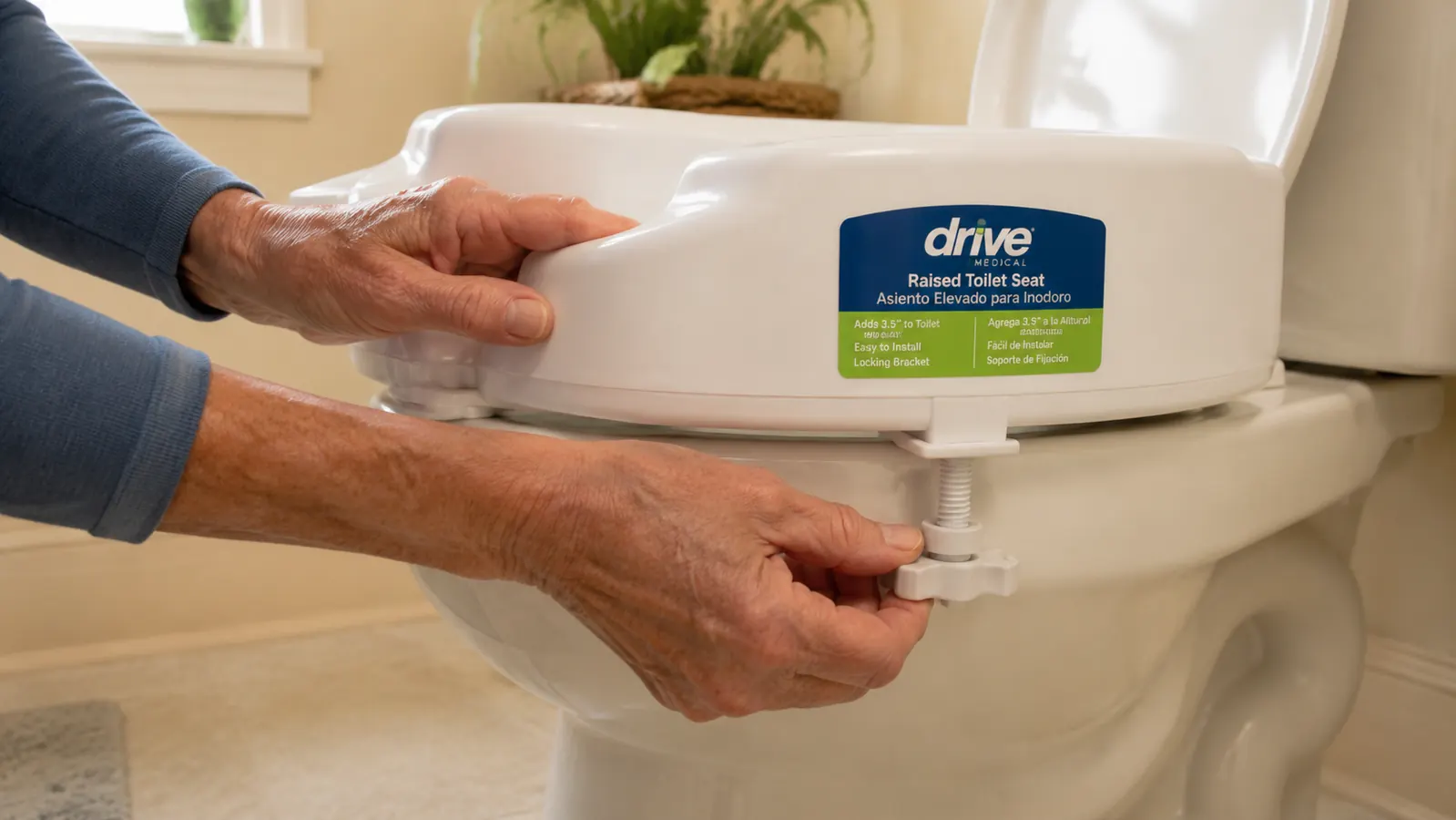
The Drive Medical seat attaches with a locking bracket that grips the underside of the toilet rim. There are no screws into the porcelain, no drilling, no permanent modification. You set the seat on the bowl, reach underneath, and tighten two plastic knobs that pull rubber-lined grips against the rim. The whole installation takes about eight minutes the first time, five minutes if you have done it before.
In three years, the clamp has loosened enough to notice exactly twice. Both times it was on my mother's toilet, which she uses more than four times a day. I noticed it because the seat had a faint side-to-side shift, maybe a quarter inch, nothing dramatic. I tightened both knobs snug and the problem went away. The seat on my wife's mother's toilet, which sees less daily use, has never needed re-tightening. My honest read is that the locking plastic threads are good quality for the price point but do compress slightly with heavy daily use over time. Check the knobs every three months. It takes 30 seconds.
One thing I will flag: do not over-tighten when you first install it. The knobs are plastic. If you reef on them like you would a bolt, you will strip the threads. Firm hand-tight is correct. You will know it is secure when the seat does not shift at all when you push on it side to side with both hands.
In three years of daily use, the seat has never wobbled during use. The clamp loosened twice and took about 30 seconds each time to fix. That is a reasonable maintenance ask for something this affordable.
The Armrests: Stability, Width, and Whether They Hold a Person's Weight
The arms are the reason most people buy this model instead of a plain elevated seat. They remove completely for cleaning and for when someone in the house does not need them. Each arm posts into a receiver on the side of the seat frame and locks with a hand-tightened knob. They are foam-padded, which matters more than I expected. My mother puts real weight on these arms every time she stands. A hard plastic edge would be uncomfortable against the forearm within a week.
The width between the arms is approximately 19.5 inches inside edge to inside edge. That is a snug fit for a larger person. If your parent is broader across the hips, say 42 inches or above, they may find the arms feel confining rather than supportive. My mother has no issue. My wife's mother, who is slightly broader, said the arms feel a bit close but she has adapted and does not find them uncomfortable. For an average-sized adult female, the width is fine. For a larger adult male, I would measure first.
The arm height is not adjustable on this model. They sit about nine inches above the seat surface. For my mother at 5 feet 4 inches, that puts her hands at a natural pushing angle when she stands. If your parent is significantly shorter or taller than average, that fixed height could be a meaningful drawback.
How Much Height It Actually Adds, and Why That Number Matters
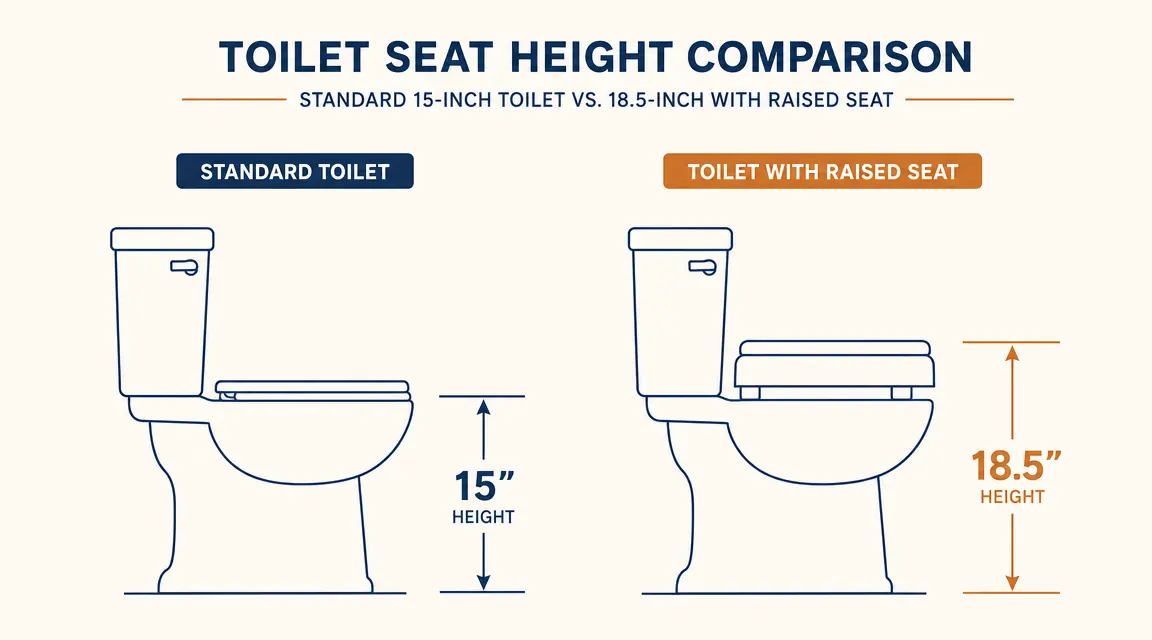
The Drive Medical seat adds 3.5 inches to the seat height. A standard American toilet bowl rim sits at about 15 to 16 inches from the floor. With this seat installed, you are sitting at roughly 18.5 to 19.5 inches, depending on your specific toilet. The orthopedic threshold most surgeons aim for after hip surgery is keeping the hips at or above knee height when seated. For most adults, that is roughly 17 to 19 inches. This seat clears that threshold on nearly any standard toilet.
There are raised seats that offer more height, some going up to five or six inches. If your parent is very tall, or if their surgeon specifically prescribed a higher clearance, you may need more than this product provides. For my mother and her surgeon's instructions, 3.5 inches was exactly sufficient. Her post-op physical therapist looked at the setup and said it was right. That was good enough for me.
Round Bowl vs Elongated Bowl: What Changes
The Drive Medical seat is marketed for standard toilets, which in manufacturer language typically means round bowls. My mother's toilet is round. The fit is clean, the seat sits flush with minimal gap between the raised seat and the toilet seat below it, and the whole assembly looks intentional.
My wife's mother has an elongated bowl. The fit works, but there is a small gap at the front of the seat, maybe an inch, where the raised seat does not fully cover the elongated bowl's extra front length. This does not create a safety issue. The seat is fully stable and the user does not feel any instability. What it does create is a cleaning inconvenience: there is a lip and small gap at the front where moisture can collect. I added wiping down that gap to the weekly cleaning routine and it has been fine. But it is worth knowing before you install.
If you have an elongated toilet and this gap bothers you, Drive Medical does make an elongated version of this seat. Check the product listing carefully before ordering, as both show up in Amazon searches and the photos look nearly identical.
The Cleaning Routine After Three Years
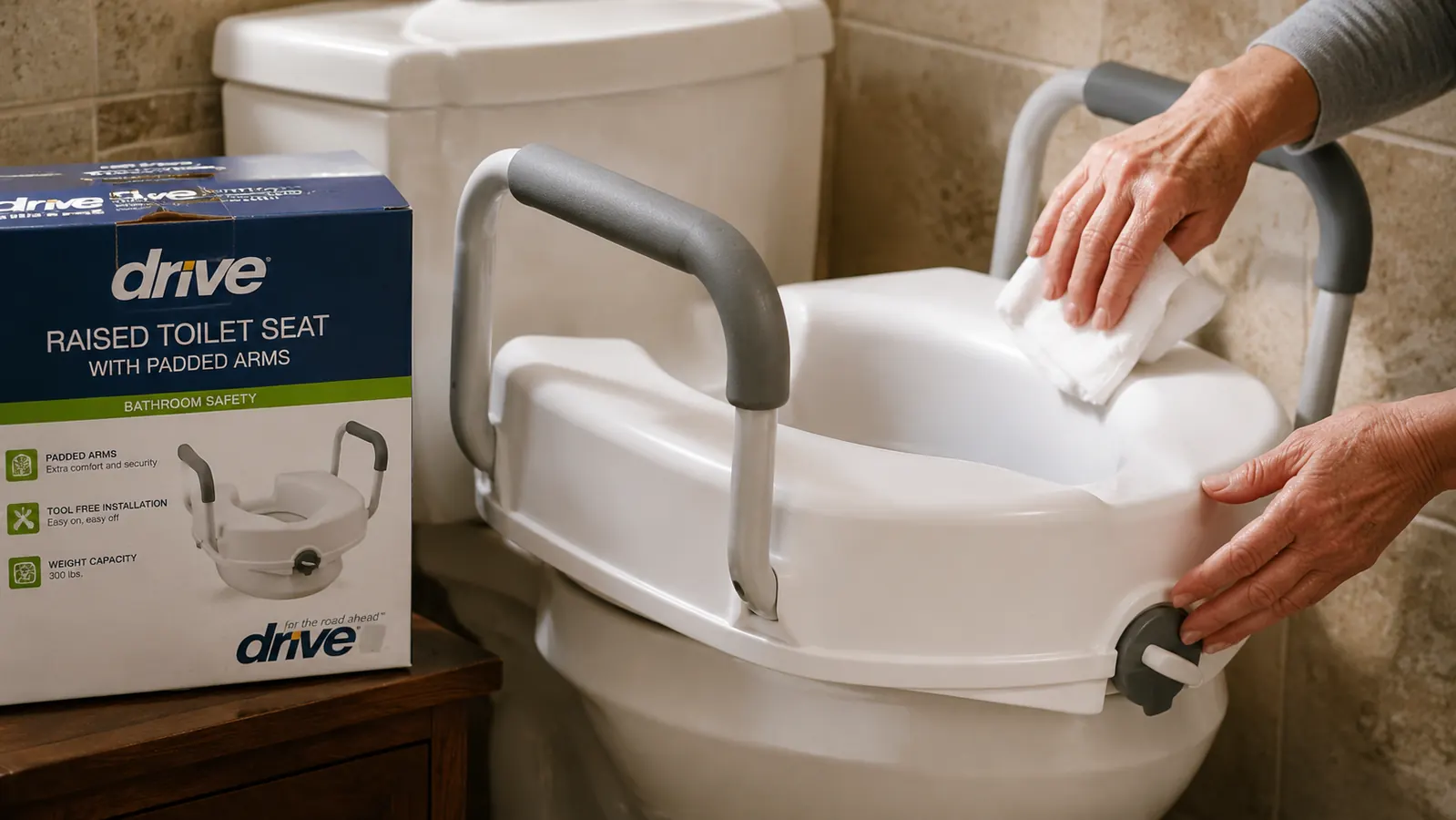
My cleaning routine is straightforward. Once a week, I remove both armrests, spray the seat and the rim of the toilet below it with a bathroom disinfectant spray, let it sit for two minutes, and wipe everything down with paper towels or a cleaning cloth. I wipe the foam-padded arm tops and the hard plastic underside of each arm. Then I reattach the arms.
After three years, the white plastic has some minor yellowing on the underside, which is normal for any white plastic that lives in a bathroom. The foam padding on the armrests is still intact on both arms on the first seat and on both arms of the second. No cracking, no peeling, no smell. I use standard bathroom spray cleaner and that is all it needs. I have not used bleach directly on it because I did not want to accelerate any material breakdown, but a diluted bleach solution would almost certainly be fine if needed.
One practical note: the underside of the seat accumulates more grime than you expect, because it sits close to the toilet bowl. Lift it and clean the underside at least monthly. It takes two extra minutes and makes a real difference in keeping the bathroom genuinely clean.
What I Liked
- Rock solid after three years of daily use by a post-surgical patient at 147 lbs
- Clamp mechanism installs in under 10 minutes with no tools
- Foam-padded armrests are genuinely comfortable under daily forearm pressure
- Arms remove completely for easy cleaning and for guests who do not need them
- At the price point, one of the best-reviewed options in this category on Amazon
- Replacement parts are available if the arms or knobs ever need swapping
Where It Falls Short
- Arm width of 19.5 inches is snug for broader adults
- Arm height is fixed, not adjustable up or down
- Does not fit elongated bowls as cleanly as round bowls, leaves a small front gap
- Locking knobs need re-tightening every few months under heavy daily use
- Only adds 3.5 inches, which may not be enough for very tall users or higher post-surgical requirements
Who This Is For
This seat is built for the situation most caregivers find themselves in: a parent or spouse coming home from a hip or knee surgery, or a person who is getting unsteady and needs more height to sit and stand safely on the toilet. It works for someone in the 120 to 200 pound range, average height, round-bowl toilet. If your parent is coming home from surgery and you need something installed before they walk through the door, this is the right choice. It is affordable, ships fast from Amazon, and requires nothing beyond your two hands to install.
It also works as a permanent addition for someone who has ongoing mobility limits, arthritis in the hips or knees, or general weakness that makes sitting down to a low toilet painful. My mother's hip has fully recovered from surgery, but she still uses the raised seat. Getting up from a standard toilet height became genuinely difficult for her in her late 70s even without a surgical reason, and this seat removes that difficulty cleanly. We never took it off because we never had a reason to.
Who Should Skip It
If your parent is larger, meaning significantly broader than average at the hips or thighs, the 19.5-inch arm spacing will feel confining. I would look at the Drive Medical Deluxe Folding Toilet Safety Rail instead, which gives grab points without the fixed-width arm restriction. If the toilet in question is elongated and the gap at the front would genuinely bother the user or create a cleaning burden you are not willing to take on, either get the elongated-specific version or consider a different product. And if the surgeon specifically said the person needs more than four inches of additional height, this seat will not get you there.
I'd also steer people away from this if the toilet itself is already a comfort-height model, meaning it sits at 17 to 19 inches from the floor naturally. Adding 3.5 inches to that would put the user at 20 to 22 inches, which is very high and could actually make the toilet harder to use safely. Measure your toilet rim height before you order. A tape measure takes 10 seconds.
For more on how the raised seat compares to a toilet safety rail, and which one makes more sense for your situation, see my piece on the raised toilet seat vs toilet safety rail comparison. And if you are still deciding whether your parent actually needs one, the 10 reasons a raised toilet seat matters after hip or knee surgery article covers every argument the surgeon's discharge sheet does not explain.
Three years in, this seat is still the first thing I'd tell any caregiver to order before their parent comes home from surgery.
It installs in ten minutes, costs less than a co-pay, and removes one of the most physically demanding moments of the day for a recovering or mobility-limited adult. Check current availability and today's price on Amazon.
Amazon Check Today's Price on Amazon →