

My father-in-law, Gerald, is 79 years old, weighs about 195 pounds, and until two years ago, his idea of a mobility aid was a wooden cane he refused to use. After his second stumble on the driveway in the fall of 2024, his doctor used the words "fall risk" and that was the end of the debate. My wife and I ordered the Drive Medical Rollator Walker with Seat that same evening. That was eighteen months ago. He has used it nearly every day since, outdoors, in grocery stores, at the VA clinic, and on one memorable trip to the farmers market where he walked farther than he had in two years. I want to tell you what this walker looks like after that kind of use, because most reviews are written in the first two weeks.
If you are standing in front of a computer right now trying to figure out what to get for your parent or your spouse because someone said they need more support, this is the article I wish I had found. The star count on Amazon is over 50,000 reviews. That tells you it works for a lot of people. What it does not tell you is what wears first, whether the brakes still hold after daily use, how the seat holds up, and whether a 79-year-old can figure out how to fold it without help. Those are the things I can tell you.
The Quick Verdict
A well-built, practical rollator that holds up to daily outdoor use. The brakes are the best thing about it and they stay reliable. The seat is low for tall users, and the basket is shallower than it looks in photos. Still the walker I would buy again.
Amazon Check Today's Price →If a fall risk stopped your parent from going anywhere, this rollator puts them back in motion.
The Drive Medical Rollator Walker has a 350-pound weight limit, 7.5-inch wheels, and loop brakes that are easy to squeeze for older hands. Check today's price on Amazon before you keep reading.
Amazon Check Today's Price on Amazon →How Gerald Has Used It
Gerald does a morning walk every day when the weather allows, about a quarter mile down the sidewalk and back. He uses the walker the whole way. On Tuesdays we take him to the grocery store, where he pushes it through the entire store and uses the seat to rest near the checkout line. About twice a month we fold it into the trunk of my wife's Camry and drive him to a doctor's appointment or to run errands. He is not a careful person with equipment. He has bumped it into doorframes, rolled it across grass and gravel, and set it down hard on concrete more times than I can count. It has lived outdoors on his covered porch every night since we bought it.
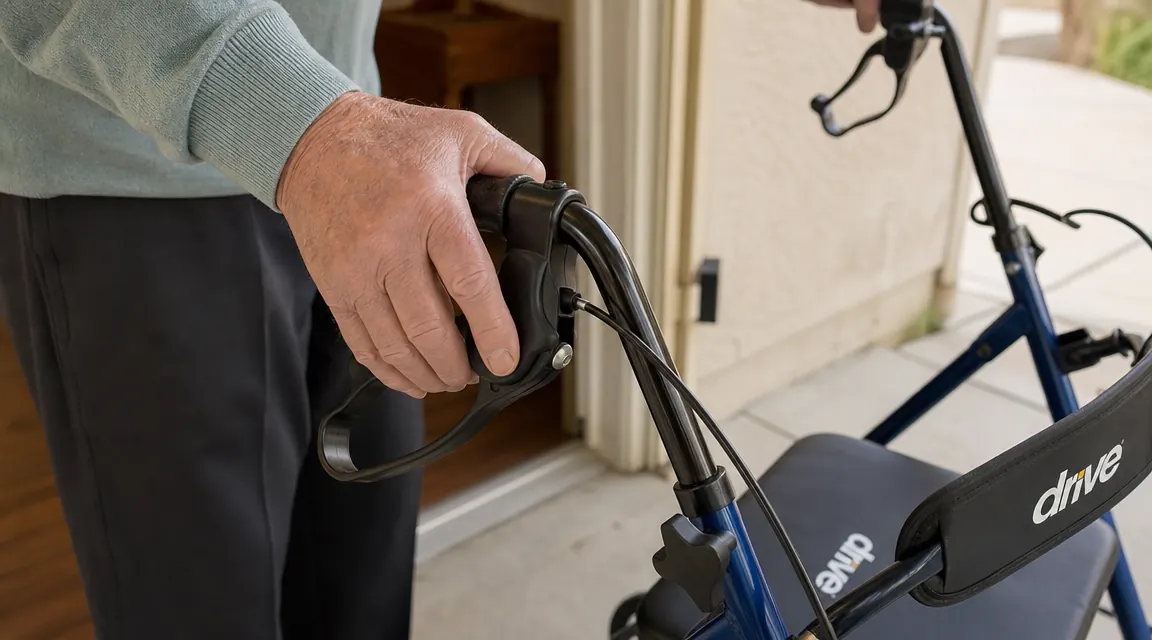
The first thing I checked at the six-month mark was the brakes. That is the part I was most nervous about. If the brakes go soft, the walker becomes a liability instead of a support. At six months they were still firm. At twelve months, same thing. Today, at eighteen months, the loop brakes on both handles require the same pressure they required on day one. That is the single best thing I can tell you about this walker.
The wheels roll quietly on smooth pavement and adequately on rough sidewalk seams. On grass they push harder, which is expected on 7.5-inch wheels. Gerald has learned to avoid the softest patches of lawn, but short-cut trips across the yard do work. On grocery store tile they glide almost silently, which matters more than you'd think because Gerald is a proud man and he does not want people staring at him.
The Brakes: What You Need to Know Before Anyone Uses This Walker
The Drive Medical uses loop brakes, which means the user squeezes the whole handle down to brake, rather than pressing a lever from above. For most older adults, this design is easier on arthritic fingers because you are using your whole hand rather than just your index finger. Gerald has some stiffness in his right hand from an old work injury. He has never had a problem engaging these brakes. That matters a lot to me.
One thing to know: the brakes double as a parking lock. You push the handles down and the rollator stays put while the user sits or reaches for something. This is different from a standard walker and takes a few days to become habit. Gerald figured it out by week two and now uses the lock instinctively every time he sits on the seat. When you are first setting up this walker for someone, spend ten minutes practicing the lock-and-sit move before they use it on their own. It is not complicated but the first few times feel uncertain.
At eighteen months, the loop brakes require the same pressure they did on day one. That is the single best thing I can tell you about this walker.
The Seat: Honest Assessment After Eighteen Months
The seat is padded and firm. It is not a cushion. It is more like the kind of padding you would find on a gym bench. For short rests, five to ten minutes, it is fine. Gerald sits on it at the checkout line, at the farmers market, and sometimes mid-walk when his hip gets tight. He has never complained about it being uncomfortable for those kinds of brief stops.
Two honest caveats. First, the seat height. Gerald is 5-foot-10 and when he sits on this rollator his knees are noticeably above his hips, which means his weight is tipped slightly forward. He is not uncomfortable but it is not ideal posture. If your person is shorter than five-foot-eight, the seat height will work better for them. If they are taller, this is a detail to be aware of. Second, the seat padding has softened a little over eighteen months. It is not worn out, but it is slightly less firm than it was. For a short rest this is still fine. For sitting at a meal or for more than fifteen minutes, I would bring a separate cushion.
The seat also has a storage compartment underneath it. Lift the seat and there is a pouch. Gerald uses it for his wallet and a small water bottle when he walks. We have never had the latch pop open on its own. After eighteen months the latch still clicks securely.

The Basket: What It Actually Holds
The basket below the seat is smaller than it appears in most product photos. It is roughly the size of a large purse interior, maybe ten inches wide by eight inches deep. It holds a jacket, a small bag of groceries, or a medium-sized tote bag. It does not hold a full grocery run. Gerald uses it primarily for his jacket on cool mornings when he warms up mid-walk and needs to take it off, and for the small canvas bag he carries to the farmers market.
The basket is fabric-lined wire and it has held up well. No sagging, no tearing. The wire frame has one small bend near the right front corner from when Gerald rolled it off a curb at an angle, but the basket still sits flat and functional. If you are counting on the basket to carry significant weight or volume, plan on the capacity being smaller than you expect. For incidentals and personal items it is genuinely useful.
Folding It Into the Car: The Real-World Test
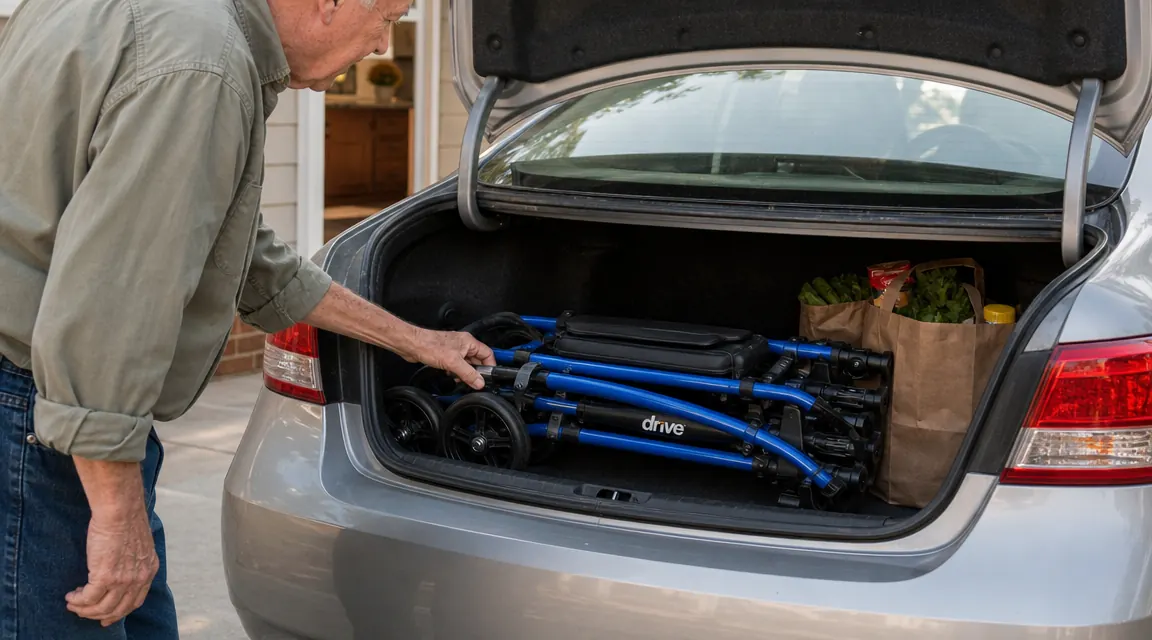
The Drive Medical folds by lifting a strap on the seat and pulling upward. The whole frame hinges in the middle and collapses down flat. It is a satisfying fold when you get the motion right. The first few times Gerald tried it himself, he missed the strap and pulled on the frame, which does not work. Once he understood that the fold starts by grabbing the fabric strap and lifting straight up, he got it on his own in about five seconds.
Folded, it fits standing up in the back seat of most sedans, or flat in the trunk. My wife loads it into the Camry trunk without difficulty. The weight is listed at 16 pounds and it feels accurate. That is light enough for most people to lift from the ground to trunk height without straining, though if the person loading it has a bad back you may want to practice the lift position before you do it in a parking lot. We use a trunk organizer alongside it and the folded walker takes up about a third of the trunk space.
One thing that has changed over time: the folding latch, which keeps the walker open during use, has become easier to operate. When it was new, it required a firm push to lock into place. Now it clicks into position with lighter pressure. That could be the latch wearing slightly or it could just be that the frame has broken in. Either way, it still holds securely in use and there has been no wobble when Gerald leans on it.
What Is Wearing Down After Eighteen Months
The grip handles have some surface wear. The textured rubber is still functional and grippy, but the ridges that were pronounced when it was new are now smoother, especially on the right handle where Gerald's grip is tighter. This has not affected safety. If your parent has very limited grip strength, this is worth monitoring over time because rubber grips that get very smooth can become slippery in wet weather.
The wheel hubs have a faint squeak on the left rear wheel that appeared around month fourteen. It happens only on hard surface turns, not during straight walking. I checked the wheel and there is no structural issue, just normal wear on the axle housing. A drop of household oil stopped it for about two weeks. It came back. At this point Gerald says it does not bother him and I have stopped fighting it. It is cosmetic noise, not a safety concern.
The blue paint on the frame has some scuffs from doorframes and loading into the car. No rust despite living outdoors on a covered porch through a Florida wet season. The steel frame construction has held up better than I expected for the price.
What I Liked
- Loop brakes stay reliable after 18 months of daily use and are easy on arthritic hands
- Folds quickly once you learn the strap-lift motion, light enough at 16 lbs for most adults to load into a car
- Frame has shown no rust after 18 months including a Florida wet season outdoors
- Quiet on tile floors, respects dignity in public spaces
- 350-pound weight limit covers most users
- Under-seat storage pouch has held up with no latch failures
Where It Falls Short
- Seat height is low for users taller than 5-foot-10, creates forward knee-above-hip posture
- Basket is shallower than product photos suggest, not a grocery-run solution
- Grip rubber shows surface wear by 12-18 months, worth monitoring for users with weak grip
- Left rear wheel developed a faint squeak at month 14, minor but persistent
Who This Is For
This rollator is right for someone who is mobile but needs stability and confidence support, especially outdoors. Gerald falls squarely in that category: he can walk on his own, but one uncertain moment on an uneven surface or a light head spin could send him down. The rollator gives him a frame to hold and the confidence to walk farther than he would without it. It is also right for someone who needs occasional seated rest during longer outings. The seat is what turned Gerald from a guy who stayed home to a guy who goes to the farmers market. If your parent would walk farther but stops because they have nowhere to sit, this walker changes that equation.
It is also a practical choice if you are regularly transporting the user and need something that folds quickly and loads without a lot of effort. For families doing weekly grocery runs or doctor appointments, the fold-and-go routine becomes very natural after a few weeks.
Who Should Skip It
If your parent is very tall, above 5-foot-11, look at whether the seat height works for them before ordering. The frame height adjusts well for handle height but the seat is fixed. Also, if your parent needs to carry significant items regularly, a rollator with a deeper basket or a bag attachment may serve them better. And if they are primarily indoors on carpet, the wheel resistance on thick carpet can make this feel laborious compared to lighter indoor models. This walker was built for pavement and smooth surfaces. That is where it excels.
Finally, if the person using it has very limited upper body strength and cannot fold the walker independently, consider whether that matters for your situation. The fold requires a firm upward pull on the strap. Most people manage it fine, but it is worth testing in the store or shortly after delivery before building any routines around it.
Eighteen months of daily use and Gerald still takes it out every morning. That is the review.
The Drive Medical Rollator Walker runs well under sixty dollars most days. For a piece of equipment that gets used every single day and gives an older adult the confidence to keep going out, the math is straightforward. Check today's price on Amazon.
Amazon Check Today's Price on Amazon →