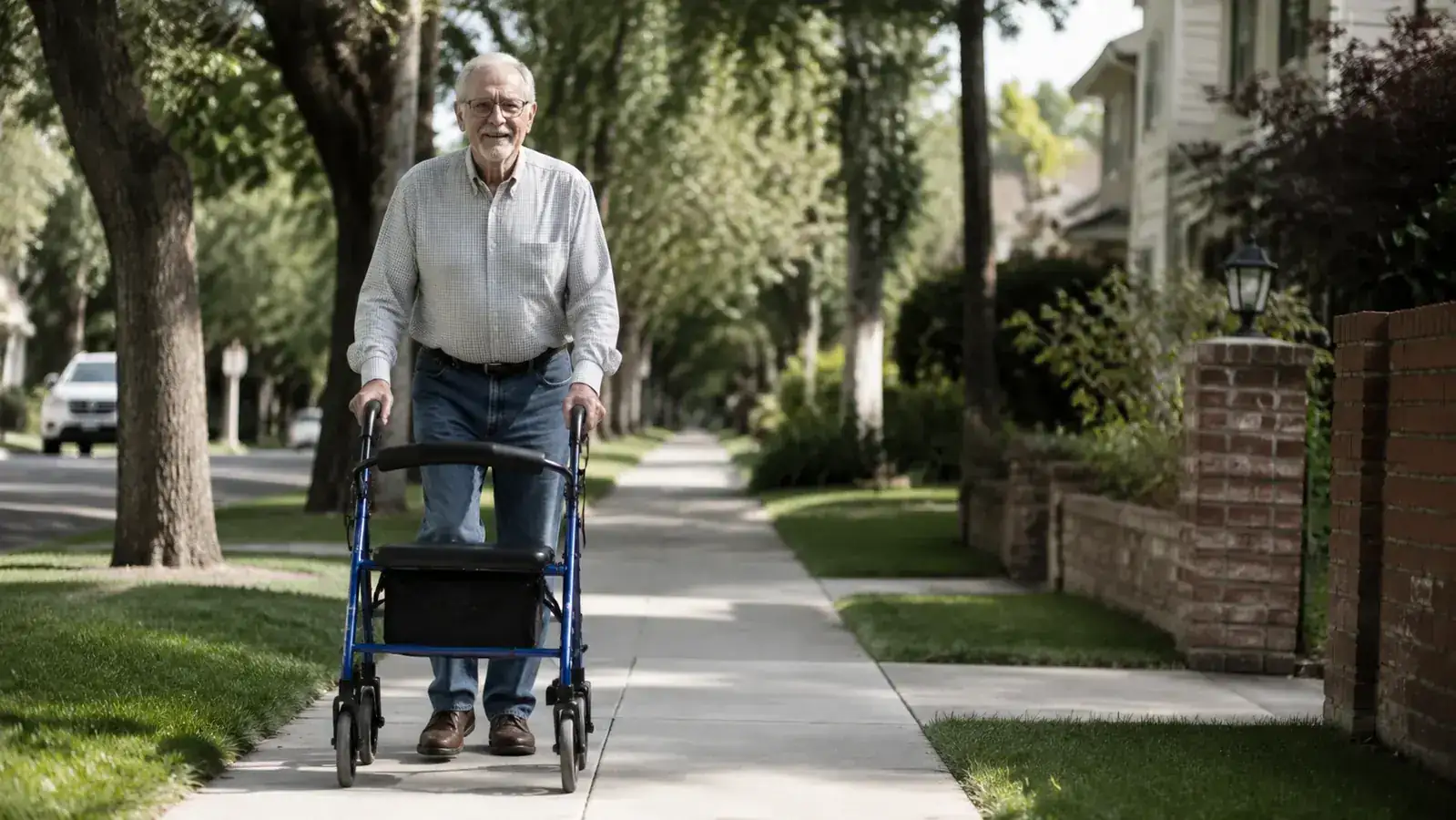
My father-in-law used a wooden cane for three years after his first fall. He was proud of it, honestly. He figured a cane was all he needed, and he did not want to look like he was older than he felt. Then he fell again, this time in a parking lot, and spent six weeks recovering. That fall was what pushed us to look harder at a rollator. Within a month he was back at the farmers market, on his own, carrying groceries in the wire basket underneath the seat. The cane is still leaning against his closet door. He has not touched it since.
If someone you care for is still relying on a cane and you are starting to worry, here are ten concrete reasons a rollator walker may be the safer, more practical choice. The Drive Medical Rollator Walker is the one we ended up with, after 18 months of daily outdoor use across pavement, gravel, and grocery store tile. I will refer to it throughout.
If a cane is not cutting it anymore, here is what we switched to.
The Drive Medical Rollator Walker has 50,000-plus Amazon reviews, a built-in seat, loop brakes, a storage basket, and folds flat for the car. It is the one we use and the one I recommend to other caregivers first.
Amazon Check Today's Price on Amazon →A Rollator Supports Your Whole Center of Gravity, Not Just One Side
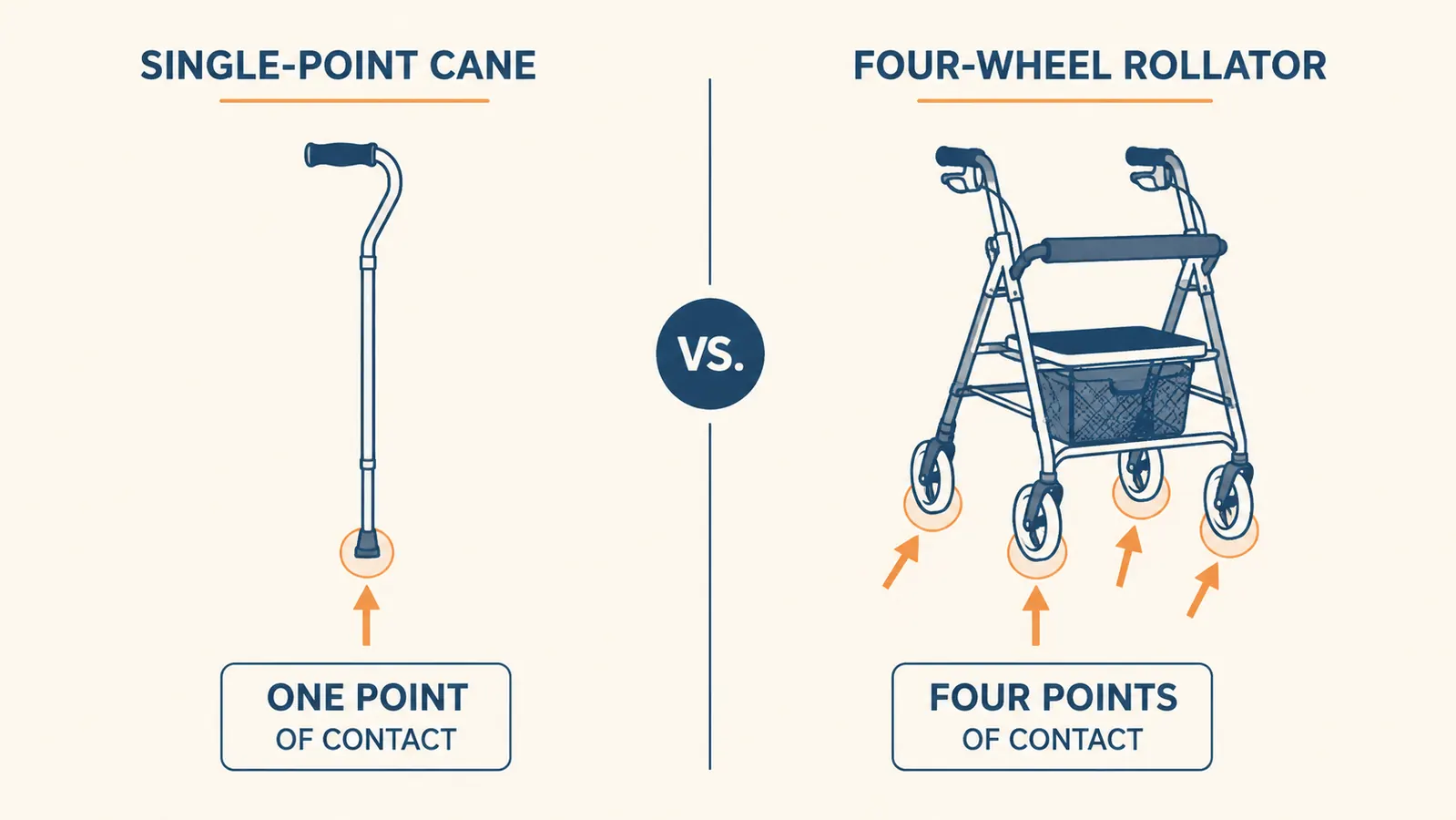
A cane offloads weight to one arm on one side. If your parent has weakness on both sides, or their balance is generally poor rather than side-specific, a cane is fighting the real problem with the wrong tool. A rollator gives you two handles in front of your body, so you are balanced left and right at the same time. The Drive Medical walker's handles are wide set and height-adjustable, so you can dial in the position that keeps the torso upright instead of hunched forward.
There Is a Seat for When Legs Give Out Mid-Walk
This is the reason my father-in-law would not go back to a cane if you paid him. When he gets tired, he turns around, reaches back for the seat, and sits. No wall to lean against, no bench to hunt for, no sitting down on a curb and hoping someone notices. The padded seat on the Drive Medical rollator is not luxurious, but it is solid and it is always right there. For anyone with cardiac conditions, chronic fatigue, or arthritis flares, the ability to rest anywhere on a walk is not a luxury. It is what makes the walk possible.
Loop Brakes Give Real Control on Slopes and Uneven Ground
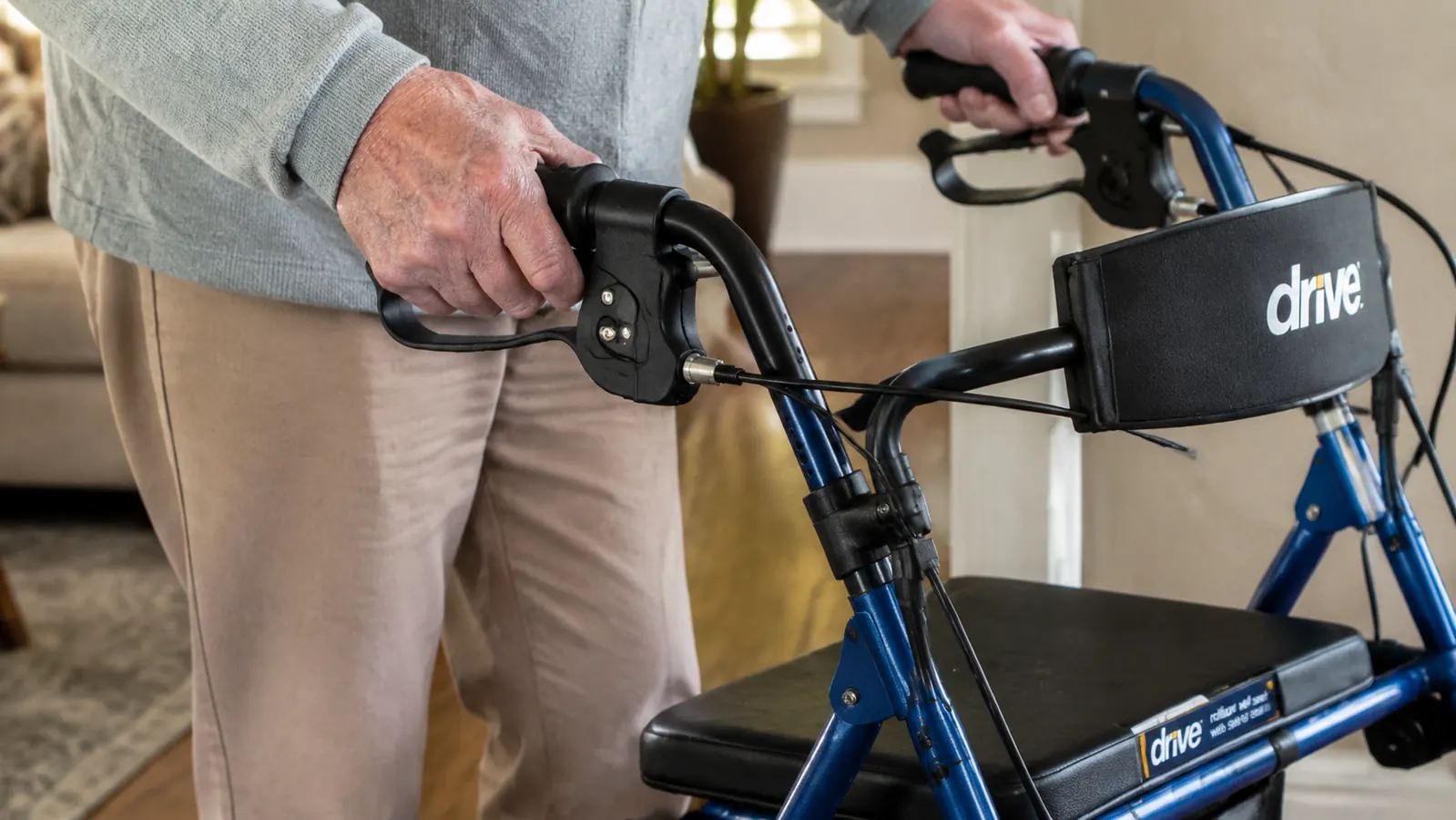
A cane does not brake. On a slight downhill or a slick floor, a cane can slip out from under you in a fraction of a second. The Drive Medical rollator uses loop brakes on both handles, the same style you see on bicycles. Squeeze them and the wheels lock. My father-in-law uses them constantly on any slope, and he learned within the first week to apply them before he sits down so the chair does not roll out from under him. That muscle memory took about three days to build.
It Folds Flat and Fits in a Standard Car Trunk
One of the practical objections I hear from caregivers is that a rollator is too big to travel with. The Drive Medical model folds with one motion and fits in the trunk of a midsize sedan with room to spare. We drove it to two different doctors' appointments in the first week and it took maybe ten seconds to fold and load each time. A cane technically fits anywhere, but if the rollator stays home because it is inconvenient, it is not helping anyone.

The Wire Basket Means Hands Are Free for Carrying Things
Think about what a cane user cannot do with their hands. Carry a bag. Hold a drink. Bring groceries from the car. With a rollator, the basket under the seat handles all of that. My father-in-law loads his farmers market bags in there and wheels them to the car himself. For someone who spent 40 years providing for their family, being able to carry their own groceries is not a small thing. It is a piece of dignity they had lost and got back.
Upright Posture Is Easier to Maintain
A cane puts the body in a slight lean toward the cane side, which over months compounds into shoulder strain and back pain. A rollator's handles are directly in front of you, chest-width apart, and when they are set to the right height the natural tendency is to stand upright. The Drive Medical rollator's handle height adjusts in two-inch increments, which sounds like a small thing until you realize that an inch too low is the difference between walking normally and hunching.
It Gives Seniors More Confidence to Go Out Alone
This is the one caregivers underestimate. When my father-in-law had the cane, he would not go anywhere without someone with him. He knew one stumble could put him down and he had no way to recover. With the rollator, he goes to the end of the block and back by himself. He goes to the mailbox. He can sit down any time he needs to. That independence is not just good for him psychologically. It is good for his body. Sedentary seniors decline faster. Anything that gets them moving on their own is doing real medical work.
Seven-and-a-Half Inch Wheels Handle Outdoor Surfaces
A lot of cheap rollators have small wheels that catch on every crack or pebble in a sidewalk. The Drive Medical model uses 7.5-inch wheels, which is enough to roll over typical outdoor surface irregularities without stopping dead or pitching forward. My father-in-law uses his on two different surfaces daily: the concrete walkway from the house and the blacktop parking lot at the grocery store. After 18 months, the wheels are showing some wear but they have not given us any trouble.
The Weight Limit Covers Most Users
The Drive Medical rollator is rated for 350 pounds. My father-in-law is 190 pounds and the frame has never flexed or felt unstable under him. Most quality rollators in this class handle a wide range of users, which matters because a lot of seniors carry more weight than they did at 50. A cane's safe working load depends on the cane, the tip condition, and the floor surface. A rollator's load rating is engineered and tested. That is a more predictable form of safety.
It Is Covered by Medicare and Many Insurance Plans
A cane costs almost nothing, and I understand why that comparison feels lopsided. But the Drive Medical rollator qualifies as a Durable Medical Equipment (DME) item under Medicare Part B with a doctor's prescription. If your parent's physician documents that a rollator is medically necessary for balance or mobility issues, Medicare may cover 80 percent after the deductible. Call the doctor's office before you order. Many caregivers pay far less than they expect to. Even without insurance, the current price is under $60.
What I Would Skip
Not every rollator is worth buying. The ultra-cheap models under $30 have wheels that wobble after two weeks, brakes that feel mushy from day one, and seats that flex when you sit on them. If the frame is not steel or aluminum, walk away. The Drive Medical model is steel, which is why it is still in service after a year and a half of real outdoor use. For a more detailed breakdown of what to look for before you buy, see my full review.
I would also skip any rollator without loop brakes. Some cheaper models use push-down rear brakes. They work in theory but they are harder to engage quickly, and quick engagement is exactly what you need when someone starts to tip forward. Loop brakes are faster and more reliable. Do not compromise on that feature.
When he gets tired, he turns around, reaches back for the seat, and sits. No wall to lean against, no bench to hunt for. That is what a rollator does that a cane simply cannot.
If you want to make sure the rollator is adjusted properly for your parent's height and posture before they use it independently, I have a plain-spoken walkthrough of every adjustment on the Drive Medical model.
Still on a cane? Here is the rollator that held up for 18 months of daily use.
The Drive Medical Rollator Walker has a built-in seat, loop brakes, 7.5-inch wheels, and a basket. It folds flat for the car and supports up to 350 pounds. Over 50,000 people reviewed it on Amazon. We have been using ours on pavement and in stores since 2024 and have not had a single problem.
Amazon Check Today's Price on Amazon →