
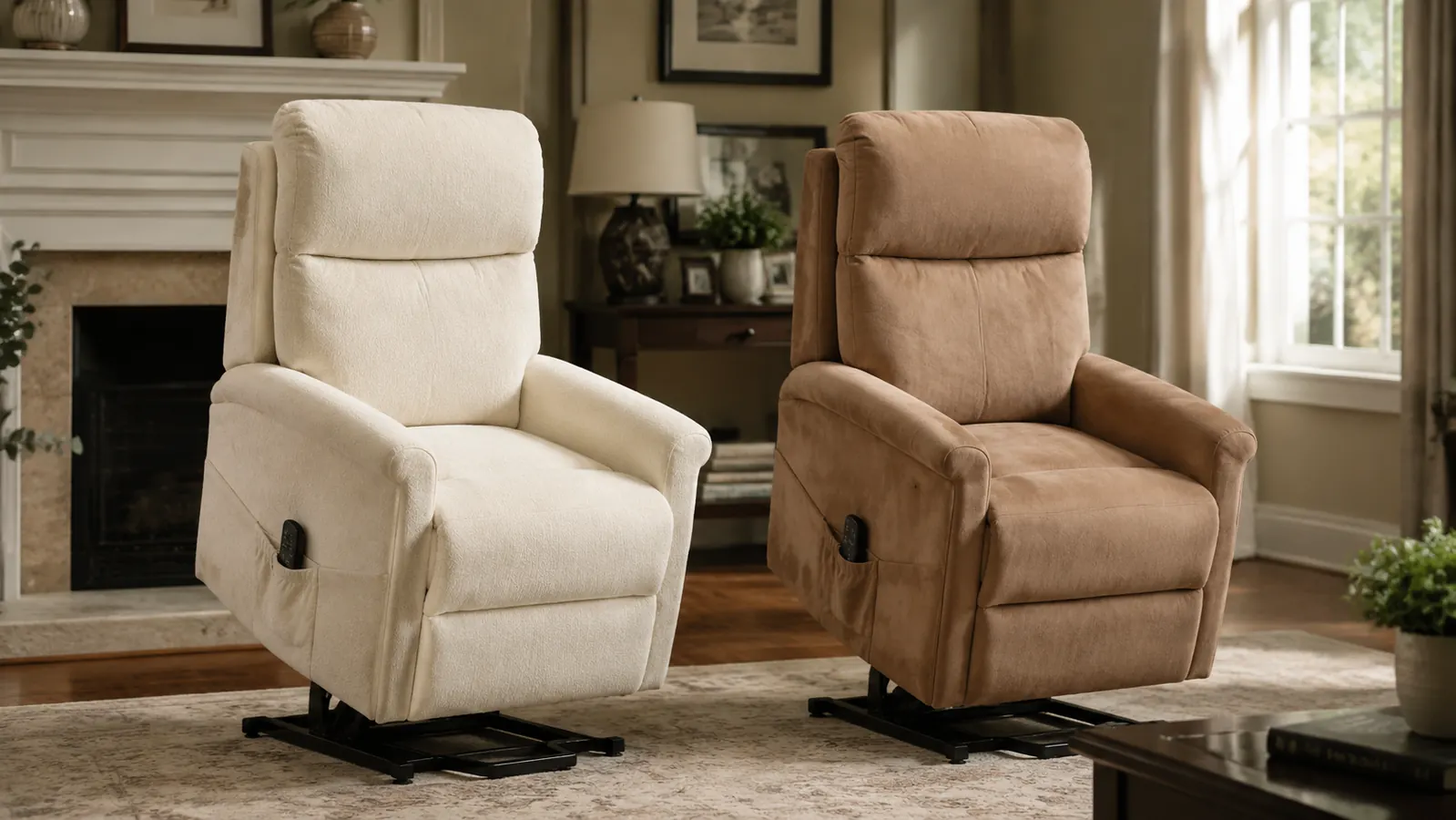
If you have spent more than twenty minutes on Amazon looking at lift chairs, you have seen both of these names. MCombo and Esright are two of the most-searched power lift recliners in the under-$600 range, they look similar in the product photos, and their descriptions use a lot of the same language. So people write to me and ask: what is actually different? My mother has used the MCombo chair in cream white for over a year now. I put hands on an Esright model at a friend's house. Here is what I found.
Short answer: both chairs work. Neither one is garbage. But they are not equal, and the differences show up in ways that matter a lot to an elderly person using the chair every day or to the caregiver who has to call customer support when something goes wrong. I'll walk through each category and tell you where each chair wins, where each one falls short, and who should buy which one.
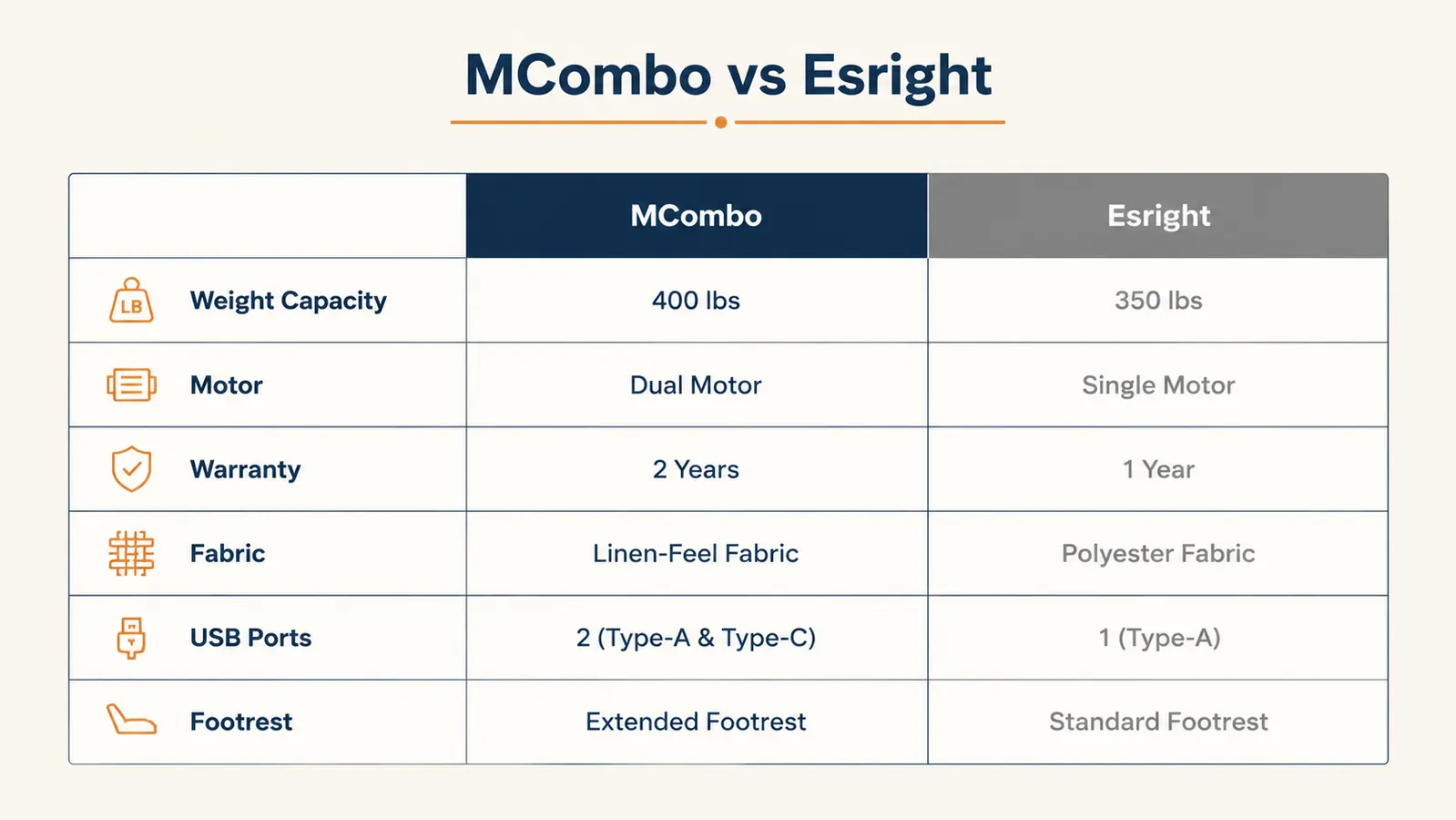
| Feature | MCombo (B0823985CQ) | Esright |
|---|---|---|
| Price range | ~$500 | ~$450-$480 |
| Weight capacity | 300 lbs | 265-300 lbs (varies by model) |
| Motor type | Single quiet motor | Single motor, louder cycle |
| Footrest style | Extended split footrest | Standard single footrest |
| USB ports | 2 side USB ports | 1 USB port (some models) |
| Cup holders | Yes, 2 | Yes, 1-2 (varies) |
| Fabric | Faux leather, multiple colors | Faux leather, fewer color options |
| Warranty | 1 year parts + motor | 1 year parts |
| Remote | 2-button wired remote | 2-button wired remote |
| Assembly | Minimal, 2 people recommended | Minimal, 2 people recommended |
Where the MCombo Wins
The motor is the first thing I noticed. My mother uses her MCombo every single evening, and in fourteen months the motor has never groaned, stuttered, or given her any cause to call me over. It runs quietly enough that she can be in the lift position while the TV is on at normal volume and she doesn't have to wait for it to stop before she can hear the show. That sounds trivial until you've heard a chair motor that sounds like a lawnmower starting up. The Esright model I sat with had a noticeably louder lift cycle. Not broken loud, just louder, and it developed a faint grinding sound after about six months of regular use according to the owner.
The extended footrest on the MCombo is also a meaningful difference. It adds a few inches of leg support past what most recliners offer, which matters for anyone with swelling in the lower legs, for post-surgery recovery, or just for taller users whose calves would otherwise hang off the edge. My mother is 5'4" and she uses that extended length every time. The Esright footrest is standard length, which is fine for most people but not a distinguishing feature.
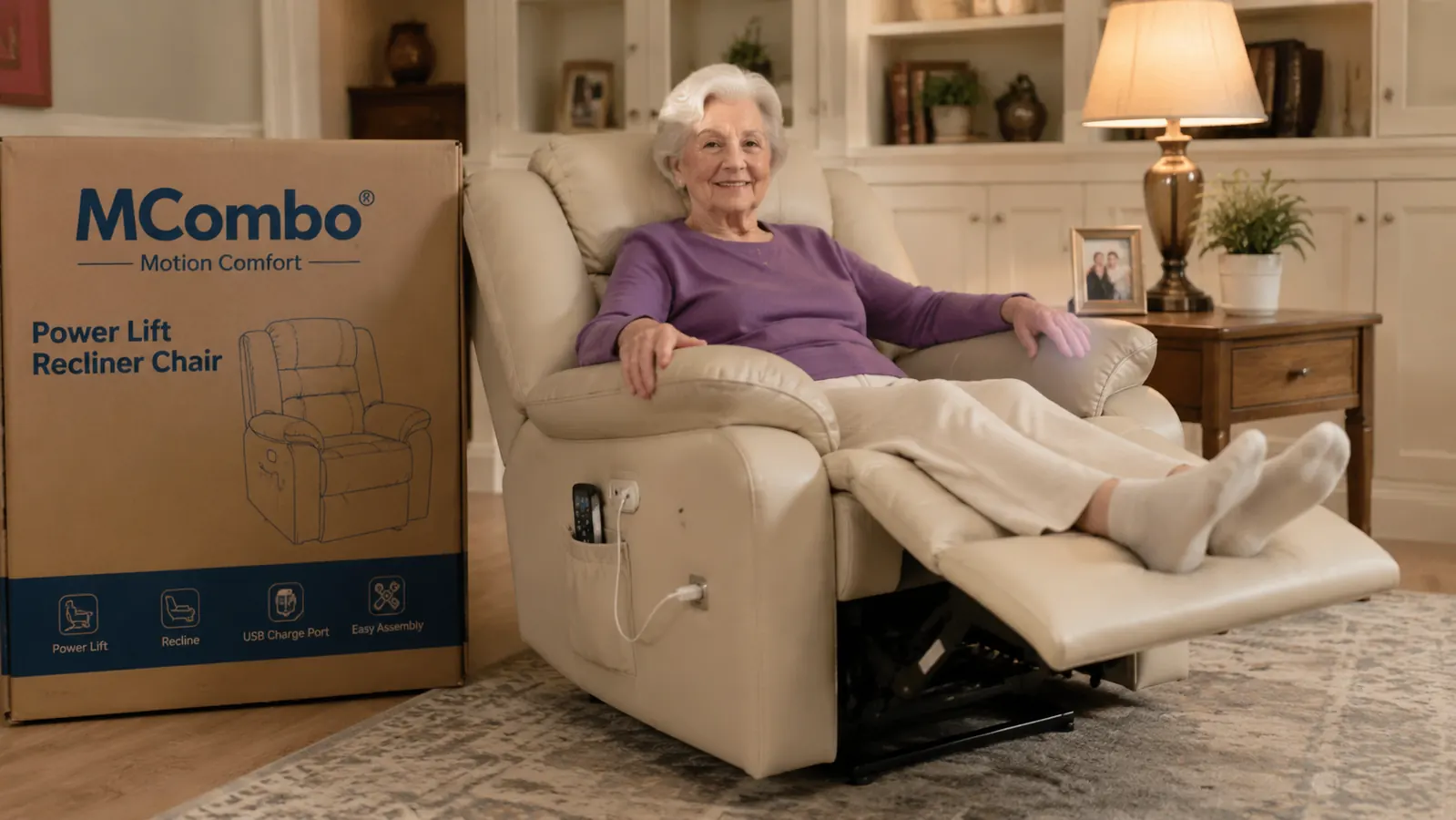
Customer support is something you don't think about until you need it. When my mother's chair arrived with a small scuff on the armrest, I contacted MCombo. I had a response within two business days and a replacement cover shipped without a fight. I've read enough one-star reviews of the Esright to know that getting a resolution there can be a longer, more frustrating process. Warranty service from a brand that actually answers is worth something, especially when the person using the chair is in their 80s and can't wait three weeks for a part.
Where the Esright Wins
Price is the honest answer. You will generally find the Esright running $30-50 less than a comparable MCombo configuration. If budget is the primary constraint and you're buying for someone who won't use the chair every day, that gap is real. The Esright is not a bad chair. It lifts, it reclines, it does the job it was built to do.
Some reviewers also prefer the Esright's seat cushion firmness, particularly shorter users who find the MCombo's medium cushion a bit too deep to sit toward the back comfortably. The Esright tends to run slightly firmer out of the box, which a subset of users prefer. That's a personal preference call, not an objective quality difference. If you can get someone to sit in both before ordering, that's worth doing. If you can't, the MCombo is the safer default for most body types.
Your parent needs the chair that works every day, not just the day it arrives.
The MCombo has been in my mother's living room for over a year. Motor still quiet, fabric still clean, footrest still extends. Check today's price on Amazon before you decide.
Amazon Check Today's Price on Amazon →Motor Quality: Why It Matters More Than People Think
A lift chair motor runs multiple times a day, every day, for years. It is not like the motor in a garage door that cycles a few times and then sits idle. An elderly person may get in and out of that chair eight or ten times a day. Multiply that by 365 days and you're looking at somewhere between 2,500 and 3,500 motor cycles in a year. The quality of that motor and the engineering behind its drive system matters for long-term reliability in a way it doesn't in a product that gets lighter use.
The MCombo uses a single quiet-cycle motor that I'd describe as steady and deliberate. It doesn't rush, it doesn't lurch, and when you release the remote button it stops cleanly. The Esright's motor works, but based on what I've heard from other caregivers, it tends to be louder and can develop noise over time. If the person using the chair has any hearing sensitivity or gets anxious at mechanical sounds, that distinction matters.
Fabric, Cleaning, and the Reality of Daily Use
Both chairs use faux leather, which is the right call for this use case. Real leather marks and dries out. Fabric absorbs spills and odors. Faux leather wipes down. My mother has had coffee, soup, and at least one full glass of iced tea land on that MCombo and every time I've wiped it off with a damp cloth and it looked fine. The seam work on the MCombo is tighter than on the Esright I looked at. That sounds like a detail until you're wiping a seam clean every week and the stitching starts pulling.
The MCombo comes in a cream white option that looks good in a living room without looking clinical. It doesn't scream medical equipment the way a grey vinyl nursing-home recliner does. That matters more than people expect. My mother cares what her living room looks like. She has opinions. The chair she sits in every day should fit the room, not make it look like a waiting area.
A lift chair motor runs 2,500 to 3,500 cycles a year. The one that's quiet on day one should still be quiet on day 730. That's the real test.
Remote Usability for Arthritic Hands
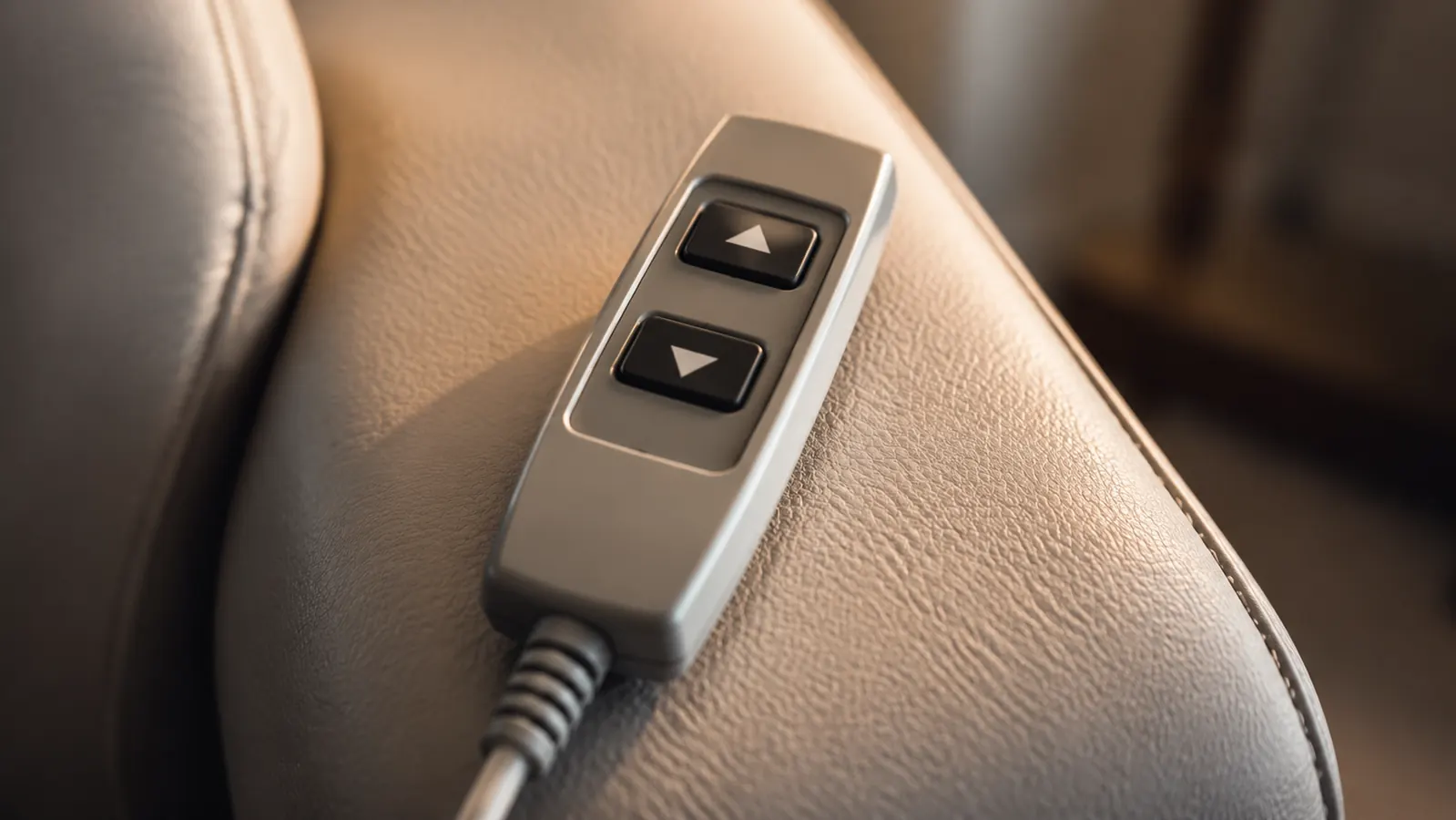
Both chairs ship with a wired two-button remote. Up and down. That simplicity is exactly right for someone with arthritis or reduced hand strength. The wired cord means the remote doesn't get lost between the cushion and the wall, which is where every wireless remote in every house ends up eventually.
The MCombo's remote buttons are slightly larger and have more tactile travel, meaning you can feel when you've pressed them without having to look. For someone whose vision is not sharp or whose fingertips have lost some sensitivity, that matters. The Esright remote is functional but the buttons are smaller and flush with the surface in some models. Not a dealbreaker, but worth noting.
Who Should Buy the MCombo
Buy the MCombo if the chair is going to be used every day by someone who depends on it, if you want a motor that won't be loud in a quiet living room, or if extended footrest support is useful for the person using it. Buy it if you want to be able to reach a responsive customer service line if something arrives damaged or develops a problem in the first year. Buy it if you want faux leather that wipes clean easily and seams that are sewn tightly enough to stay that way.
This is also the right chair if you are buying for someone who uses the chair as their primary seating. My mother does not really sit anywhere else. She's in that MCombo from after breakfast until she goes to bed. A chair that gets that kind of use needs to be built well from the start. The MCombo holds up. I have seen the proof in my own house.
Who Should Consider the Esright Instead
If budget is genuinely tight and the gap between $450 and $500 is meaningful for your household, the Esright is not a wrong choice. It lifts, it supports, and the basic function works. If the chair will be used only occasionally, perhaps as a second seating option or for a person who is still largely mobile and uses the lift assist only at the end of a long day, then the Esright's lighter-duty construction is less of a concern. If the person using it is on the lighter end of the weight range, say under 200 lbs, the reduced margin in the weight rating is less relevant.
I would not steer someone away from the Esright as a category. I would just say: if daily, year-round, primary-seating use is what you're planning, pay the extra $40-50 and get the MCombo. You will notice the difference over time.
What I Would Tell a Friend at the Table Right Now
If a friend called me and said their mother needs a lift chair and they were deciding between these two, I'd say: look at the MCombo first. The motor is better, the footrest is better, the customer service track record is better. For a $40-50 difference, those are real improvements that you will notice in month two and month eight, not just on delivery day. The Esright is a decent chair but the MCombo is a better one. If price is no constraint at all, get the MCombo. If you're right at the edge of your budget, the Esright still does the job.
My mother uses the MCombo. I've watched it work every day for over a year. I don't have second thoughts about it. That's the best endorsement I can give anything: no regrets after a year of daily use.
Still thinking about it? Check what the MCombo is selling for today.
Prices on Amazon shift. The MCombo sometimes runs promotions that bring it within $20 of the Esright, which makes the decision even easier. Check the current price and decide from there.
Amazon Check Today's Price on Amazon →